
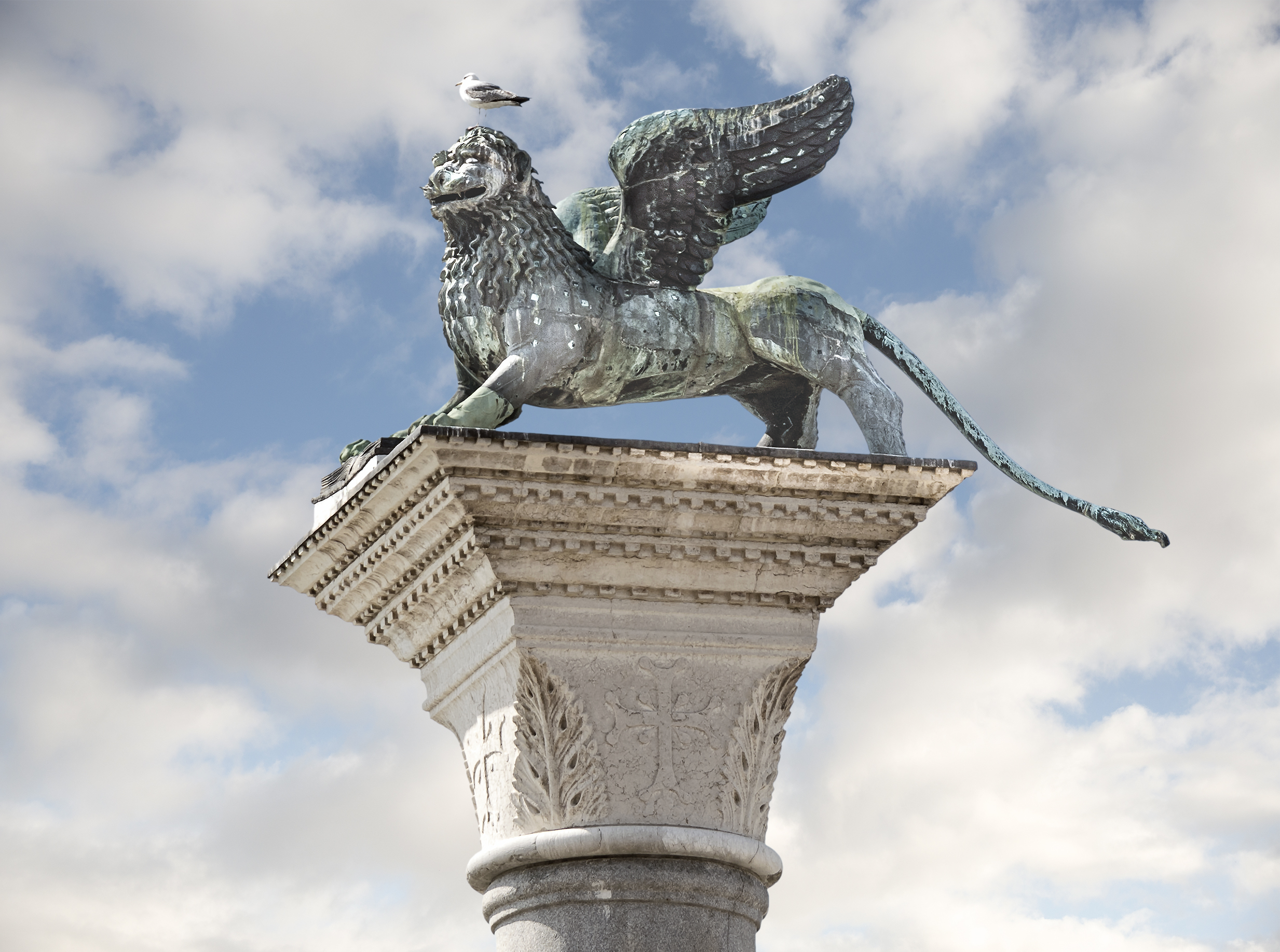
The Lion of Venice (photo courtesy of Didier Descouens)
The famous Lion of Venice, a bronze sculpture used for centuries as a symbol of the Italian city, most likely came from China, according to recent scientific studies.
The Lion of Venice is a bronze sculpture that sits atop a column in the Piazzetta di San Marco. It is one of the most famous representations of the Lion of Saint Mark, one of the most enduring symbols of the city. The symbol consists of a winged lion next to an open book representing the Gospel of Saint Mark. Saint Mark is the patron saint of Venice, and the winged lion has been used to symbolize him by many church leaders and ecclesiastical scholars. Saint Mark’s association with Venice dates back to the ninth century, when his remains were taken from Alexandria to Venice, where he was reburied in the Basilica of Saint Mark. Starting in the late thirteenth century, the Republic of Venice used the winged lion as an official symbol, appearing on its flag. The lion sculpture potentially arrived in Venice sometime in the twelfth or thirteenth century, with the first written reference dating to 1293 describing the lion as somewhat neglected and in need of restoration. The sculpture remained on top of its column until the fall of the Republic of Venice during the French Revolutionary Wars in 1797, when General Napoleon Bonaparte brought the lion to Paris as a trophy of his victorious campaigns in northern Italy.
There is no scholarly consensus as to the sculpture’s origins. While nineteenth-century historians say that the lion was made in Venice, later studies posit that the sculpture, in whole or in part, came from Greece, the Levant, or Persia. The most recent comprehensive study of the sculpture was published in 1990 by Bianca Maria Scarfi, who theorizes that the lion sculpture is “a Hellenistic interpretation of the Mesopotamian/Persian lion‑headed griffin, made in the fourth or third centuries B.C.” However, recent scientific studies indicate that the bronze used in the sculpture comes from a more distant locale. Scarfi’s study took chemical readings of different parts of the sculpture to determine their makeup. However, this data could not be used to determine the bronze’s origin since, at the time, there were no comprehensive reference databases. Specialists used mass spectroscopy to analyze multiple samples taken from the lion sculpture. They identified specific lead isotopes present in the metal as originating in the area around the lower Yangtze River in eastern China. This has led art historians to hypothesize that the original sculpture may have had its origins as a zhènmùshòu, a Chinese funerary sculpture meant to serve as guardians of temples and tombs. Given the age of the bronze, the Lion of Venice would have been made during the Tang dynasty between the seventh and tenth centuries CE.
The most thorough study of the lion’s possible Chinese origins was written by Gilberto Artiolli, Ivana Angelini, and Massimo Vidale, all of the University of Padua. Their article “A Lion on the Silk Road” was featured in the 2024 book Reimagining the Silk Roads: Interactions and Perceptions Across Eurasia, published by Routledge. They note that, stylistically, the lion’s face is not consistent with medieval Italian representational conventions. However, they do match with these Chinese tomb guardians, specifically sharing “the low forehead, bulb-like nose, lateral position of the ears, flocks under the chin, the grinning mouth and setting of the fangs, and the pronounced, convoluted wrinkling of the forehead at the root of the nose, were [sic] a round depression is visible”. The original Chinese sculptures, however, were often composites, featuring the heads and manes of lions as well as wings, the hooves of oxen, and the horns of deer or cattle. The Lion of Venice shows several markings, almost like scars, where some of these other features may have been removed. There is, however, a lack of large bronze sculptures from the time period resembling the Lion of Venice. But this lack of similar sculptures may be explained as a result of a period in Chinese history known as the Four Buddhist Persecutions, where the imperial government cracked down on the power and influence of Buddhist temples in favor of Taoism. In many cases, bronze sculptures were confiscated, broken apart, and melted down to mint currency. Surviving sculptures from the period that would have been placed on temples or tombs are therefore nearly always wood or earthenware.
This hypothesis, if proven, could significantly alter our understanding of the Lion of Venice’s historical significance and its role in the cultural exchange between East and West. As to when and how the lion came to Venice from China, Artiolli, Angelini, and Vidale hypothesize that it came along the Silk Road, possibly brought to the city in 1269 by Niccolò and Matteo Polo, the father and uncle of Marco Polo. The Italian team refers to the Chinese provenance hypothesis as “quite plausible, but admittedly not demonstrated by detailed historical sources nor, for the reasons explained above, by conclusive iconographic comparisons. […] Maybe science is helping to unravel some of these secrets.”