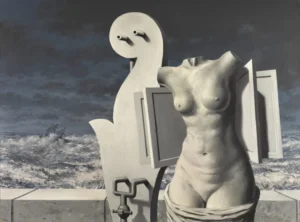
La Statue Volante by René Magritte
Last week, the first significant sale of the autumn auction season took place at Sotheby’s London with the collection of Pauline Karpidas. Since the 1970s, Karpidas has been a collector of modern and contemporary art. She is a prominent donor to the Tate Museums and the University of Manchester, donating dozens of works of art to the latter’s Whitworth Museum. While the Karpidas Collection contained a large number of works from different artists across genres, there seems to have been a strong emphasis on Surrealist art, with works by Salvador Dalí, Leonora Carrington, and Giorgio de Chirico featured in the sale.
As with any sale focusing on Surrealism, a painting by the Belgian artist René Magritte emerged as the top seller. The artist’s 1958 painting La Statue Volante shows the inclusion of several motifs Magritte had begun to use in the 1920s. A headless, armless, marble torso of a nude woman stands in front of a stormy seascape of blue and white. Behind the sculpture is a series of panels, as well as a curved shape that is almost reminiscent of the scrolls of a violin. These objects are also white, like the color of the stone, as if they are also sculpted from marble. Art historians, such as Francis Naumann, theorize that the abstract shape behind the sculpture represents another representation of the human form, in contrast to the more classical nude. The backdrop of a stormy sea is also an image that Magritte had used continuously throughout his work. His main visual reference point was a 1905 painting by the Armenian artist Vartan Makhokian, of which Magritte kept a postcard reproduction in his studio. For Magritte, a stormy ocean represented the vastness of the unknown, and therefore the world of dreams and the unconscious, which the Surrealist movement dedicated itself to exploring. As the first major Magritte painting to be brought to auction since May, La Statue Volante attracted some attention. Sotheby’s specialists assigned the painting an estimate range of £9 million to £12 million. Auctioneer Oliver Barker opened the bidding at £7.9 million, with the bid quickly rising to £8.4 million after just under forty seconds. Barker waited about two minutes for any additional bids before bringing the hammer down at that price, equivalent to $11.48 million (or £10.12 million / $13.8 million w/p). Although it sold for slightly under its minimum estimate, La Statue Volante is the most expensive work by the artist sold at auction since the Leonard & Louise Riggio sale at Christie’s New York this year, where one of Magritte’s L’empire des lumières paintings sold for $34.9 million w/p.
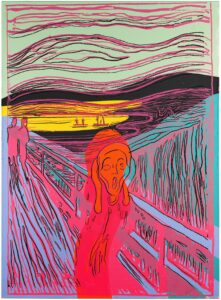
The Scream (After Munch) by Andy Warhol
While Surrealist art was the main focus of the Karpidas Collection, other genres also featured prominently, including Pop Art. Coming in behind the Magritte was one such example, The Scream (After Munch) by Andy Warhol. As one of the de facto leaders of pop art in the mid- to late twentieth century, Andy Warhol recognized that while examples of consumer culture like Campbell’s soup cans and boxes of Brillo pads were an important part of popular culture, he also recognized that fine art could also form a part of pop culture as well. When the image is famous enough, it can be reproduced and sold through posters and print reproductions. Throughout his career, Warhol gave us his own colorful spins on Botticelli’s Birth of Venus, Da Vinci’s Mona Lisa, and Paulo Uccello’s St. George and the Dragon. His reinterpretations of older paintings not only highlighted the role of art as a commodity, but they also recontextualized his own work and methods. His take on The Birth of Venus turns the painting from a mythological scene into just another one of his celebrity portraits, similar to his famous paintings and prints featuring Marilyn Monroe and Debbie Harry. Warhol also reimagined several paintings by Edvard Munch during his career. He previously cited both Munch and Matisse as his favorite artists. He was invited by the Norwegian gallerist Tor Uppstrom to create a series of fifteen reinterpretations of works by Munch, including The Scream. Sotheby’s specialists call these works “a convergence of two artistic minds grappling with the same enduring human condition — anxiety in the face of modern life.” Pauline Karpidas acquired this work at a sale at Sotheby’s in 1996. However, these Warhol/Munch works have become somewhat of a rarity, with none of them having come to auction since 2010. Therefore, it was not particularly surprising when the bidding exceeded the £3 million high estimate assigned by Sotheby’s, eventually reaching £5.4 million / $7.38 million (or £6.6 million / $9 million w/p).
Finally, coming in third was an oil painting dated around 1941 by Francis Picabia. The artist is often associated with several different styles and genres, dabbling in Dada, Surrealism, and Cubism at various points in his career. The painting Deux Amies comes from a very specific point in his life. In the summer of 1940, not long after the invading Nazis took over the French capital, Picabia moved from Paris to the south of France. From then on, he decided to focus on a rather unusual subject. He began creating female nude paintings. While this genre of figure painting was nothing new, he still sought to challenge many of the older, academic norms surrounding figure painting by drawing inspiration from pinup photography and cheap erotic magazines. For Deux Amies, art historians have been able to narrow down the specific issue the artist drew from to create this image. The painting is somewhat of a collage, combining photographs of the same model in two different poses featured in the April 1937 issue of Paris Sex-Appeal. Picabia’s use of not only mass media but mass media of a titillating or lascivious nature was, according to Sotheby’s, “bridging the low with the lofty, the kitsch with the divine”, becoming a precursor to the pop art of Andy Warhol and Jeff Koons. Although not as abstract as some of his other work, the paintings from this period are, nonetheless, incredibly important in the trajectory of both Picabia’s style and Western art in general. The painting eventually sold on the higher end of its £2.2 million to £2.8 million estimate range, landing at £2.7 million / $3.7 million (or £3.3 million / $4.55 million w/p).
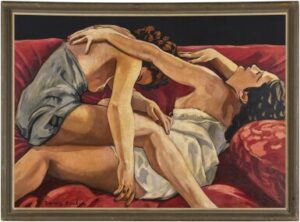
Deux Amies by Francis Picabia
Typically, with prominent single-collector sales, there aren’t that many surprises since the estimates are already in the millions, so it would take a far greater amount of money to push the hammer price of a given lot into selling for an exponentially higher amount than expected. However, there were indeed a small handful of surprises on Wednesday. Nine of the fifty-five lots sold for more than double their high estimates, accounting for approximately 16% of the entire auction. Six of those lots are by the same artist, the French sculptor Claude Lalanne. Along with her husband, François-Xavier Lalanne, Claude Lalanne became one of the most prominent French sculptors between the 1950s and 2000s, creating works of both fine and decorative art. While François-Xavier preferred animal subjects, Claude greatly employed the imagery of plants, flowers, and other vegetation. At Sotheby’s on Wednesday, the biggest surprise of the evening came in the form of Claude’s Unique Structure Végétale Mirror and Wall Light. Lalanne created this mirror in 1995, primarily from bronze patinated with gold, and decorated with leaves crafted from galvanized copper. Pauline Karpidas owned several mirrors by the artist, with Sotheby’s singling this one out as the best. Estimated to sell for no more than £450K, the Lalanne mirror reached this figure after thirty seconds of bidding. Barker allowed the bidding to continue for another 11 minutes, the hammer Price skyrocketing to over six times the high estimate at £2.9 million / $3.96 million (or £3.6 million / $4.9 million w/p). The mirror became the second most-expensive work by the artist sold at auction, surpassing a different mirror also owned by Pauline Karpidas, which sold at Sotheby’s Paris in 2023 for €4.4 million (or $4.6 million).
Sotheby ended up doing exceptionally well on Wednesday. Of the fifty-five available lots, sixteen sold within their estimates, giving Sotheby’s a 29% accuracy rate. While twelve lots (22%) sold below their estimates, an incredible twenty-seven lots (49%) sold over. With no lots going unsold, the Karpidas Collection evening sale achieved a 100% sell-through rate. Against a total high estimate of £55 million, the evening sale collection generated a total of £64.7 million, equivalent to approximately $88.4 million.

Sotheby’s Karpidas Collection Evening Sale
La Statue Volante by René Magritte
Last week, the first significant sale of the autumn auction season took place at Sotheby’s London with the collection of Pauline Karpidas. Since the 1970s, Karpidas has been a collector of modern and contemporary art. She is a prominent donor to the Tate Museums and the University of Manchester, donating dozens of works of art to the latter’s Whitworth Museum. While the Karpidas Collection contained a large number of works from different artists across genres, there seems to have been a strong emphasis on Surrealist art, with works by Salvador Dalí, Leonora Carrington, and Giorgio de Chirico featured in the sale.
As with any sale focusing on Surrealism, a painting by the Belgian artist René Magritte emerged as the top seller. The artist’s 1958 painting La Statue Volante shows the inclusion of several motifs Magritte had begun to use in the 1920s. A headless, armless, marble torso of a nude woman stands in front of a stormy seascape of blue and white. Behind the sculpture is a series of panels, as well as a curved shape that is almost reminiscent of the scrolls of a violin. These objects are also white, like the color of the stone, as if they are also sculpted from marble. Art historians, such as Francis Naumann, theorize that the abstract shape behind the sculpture represents another representation of the human form, in contrast to the more classical nude. The backdrop of a stormy sea is also an image that Magritte had used continuously throughout his work. His main visual reference point was a 1905 painting by the Armenian artist Vartan Makhokian, of which Magritte kept a postcard reproduction in his studio. For Magritte, a stormy ocean represented the vastness of the unknown, and therefore the world of dreams and the unconscious, which the Surrealist movement dedicated itself to exploring. As the first major Magritte painting to be brought to auction since May, La Statue Volante attracted some attention. Sotheby’s specialists assigned the painting an estimate range of £9 million to £12 million. Auctioneer Oliver Barker opened the bidding at £7.9 million, with the bid quickly rising to £8.4 million after just under forty seconds. Barker waited about two minutes for any additional bids before bringing the hammer down at that price, equivalent to $11.48 million (or £10.12 million / $13.8 million w/p). Although it sold for slightly under its minimum estimate, La Statue Volante is the most expensive work by the artist sold at auction since the Leonard & Louise Riggio sale at Christie’s New York this year, where one of Magritte’s L’empire des lumières paintings sold for $34.9 million w/p.
The Scream (After Munch) by Andy Warhol
While Surrealist art was the main focus of the Karpidas Collection, other genres also featured prominently, including Pop Art. Coming in behind the Magritte was one such example, The Scream (After Munch) by Andy Warhol. As one of the de facto leaders of pop art in the mid- to late twentieth century, Andy Warhol recognized that while examples of consumer culture like Campbell’s soup cans and boxes of Brillo pads were an important part of popular culture, he also recognized that fine art could also form a part of pop culture as well. When the image is famous enough, it can be reproduced and sold through posters and print reproductions. Throughout his career, Warhol gave us his own colorful spins on Botticelli’s Birth of Venus, Da Vinci’s Mona Lisa, and Paulo Uccello’s St. George and the Dragon. His reinterpretations of older paintings not only highlighted the role of art as a commodity, but they also recontextualized his own work and methods. His take on The Birth of Venus turns the painting from a mythological scene into just another one of his celebrity portraits, similar to his famous paintings and prints featuring Marilyn Monroe and Debbie Harry. Warhol also reimagined several paintings by Edvard Munch during his career. He previously cited both Munch and Matisse as his favorite artists. He was invited by the Norwegian gallerist Tor Uppstrom to create a series of fifteen reinterpretations of works by Munch, including The Scream. Sotheby’s specialists call these works “a convergence of two artistic minds grappling with the same enduring human condition — anxiety in the face of modern life.” Pauline Karpidas acquired this work at a sale at Sotheby’s in 1996. However, these Warhol/Munch works have become somewhat of a rarity, with none of them having come to auction since 2010. Therefore, it was not particularly surprising when the bidding exceeded the £3 million high estimate assigned by Sotheby’s, eventually reaching £5.4 million / $7.38 million (or £6.6 million / $9 million w/p).
Finally, coming in third was an oil painting dated around 1941 by Francis Picabia. The artist is often associated with several different styles and genres, dabbling in Dada, Surrealism, and Cubism at various points in his career. The painting Deux Amies comes from a very specific point in his life. In the summer of 1940, not long after the invading Nazis took over the French capital, Picabia moved from Paris to the south of France. From then on, he decided to focus on a rather unusual subject. He began creating female nude paintings. While this genre of figure painting was nothing new, he still sought to challenge many of the older, academic norms surrounding figure painting by drawing inspiration from pinup photography and cheap erotic magazines. For Deux Amies, art historians have been able to narrow down the specific issue the artist drew from to create this image. The painting is somewhat of a collage, combining photographs of the same model in two different poses featured in the April 1937 issue of Paris Sex-Appeal. Picabia’s use of not only mass media but mass media of a titillating or lascivious nature was, according to Sotheby’s, “bridging the low with the lofty, the kitsch with the divine”, becoming a precursor to the pop art of Andy Warhol and Jeff Koons. Although not as abstract as some of his other work, the paintings from this period are, nonetheless, incredibly important in the trajectory of both Picabia’s style and Western art in general. The painting eventually sold on the higher end of its £2.2 million to £2.8 million estimate range, landing at £2.7 million / $3.7 million (or £3.3 million / $4.55 million w/p).
Deux Amies by Francis Picabia
Typically, with prominent single-collector sales, there aren’t that many surprises since the estimates are already in the millions, so it would take a far greater amount of money to push the hammer price of a given lot into selling for an exponentially higher amount than expected. However, there were indeed a small handful of surprises on Wednesday. Nine of the fifty-five lots sold for more than double their high estimates, accounting for approximately 16% of the entire auction. Six of those lots are by the same artist, the French sculptor Claude Lalanne. Along with her husband, François-Xavier Lalanne, Claude Lalanne became one of the most prominent French sculptors between the 1950s and 2000s, creating works of both fine and decorative art. While François-Xavier preferred animal subjects, Claude greatly employed the imagery of plants, flowers, and other vegetation. At Sotheby’s on Wednesday, the biggest surprise of the evening came in the form of Claude’s Unique Structure Végétale Mirror and Wall Light. Lalanne created this mirror in 1995, primarily from bronze patinated with gold, and decorated with leaves crafted from galvanized copper. Pauline Karpidas owned several mirrors by the artist, with Sotheby’s singling this one out as the best. Estimated to sell for no more than £450K, the Lalanne mirror reached this figure after thirty seconds of bidding. Barker allowed the bidding to continue for another 11 minutes, the hammer Price skyrocketing to over six times the high estimate at £2.9 million / $3.96 million (or £3.6 million / $4.9 million w/p). The mirror became the second most-expensive work by the artist sold at auction, surpassing a different mirror also owned by Pauline Karpidas, which sold at Sotheby’s Paris in 2023 for €4.4 million (or $4.6 million).
Sotheby ended up doing exceptionally well on Wednesday. Of the fifty-five available lots, sixteen sold within their estimates, giving Sotheby’s a 29% accuracy rate. While twelve lots (22%) sold below their estimates, an incredible twenty-seven lots (49%) sold over. With no lots going unsold, the Karpidas Collection evening sale achieved a 100% sell-through rate. Against a total high estimate of £55 million, the evening sale collection generated a total of £64.7 million, equivalent to approximately $88.4 million.