
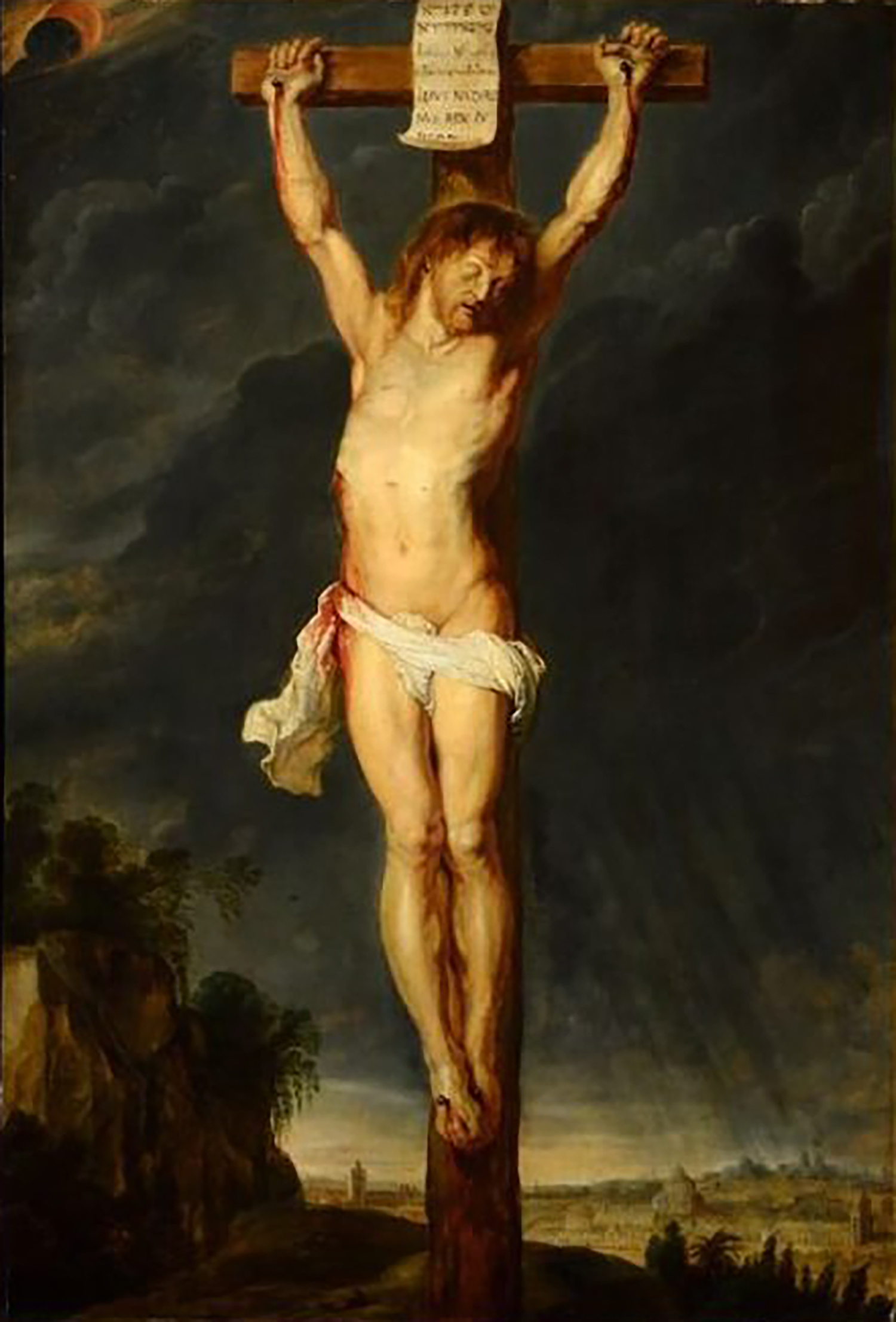
Christ on the Cross by Peter Paul Rubens
A French auctioneer has rediscovered a lost masterpiece by the Baroque Flemish painter Peter Paul Rubens.
Christ on the Cross has allegedly been missing since shortly after its creation in the second decade of the seventeenth century. And now, Jean-Pierre Osenat, who runs the auction house Osenat, claims to have found the painting in a Paris mansion. He says he came across the 41.5-by-28.5-inch work while cataloguing the inventory of a home in the city’s 6th arrondissement, traditionally a hub of artistic and intellectual life in the French capital. Since then, the painting has been authenticated by Dr. Nils Büttner, a professor at the Stuttgart State Academy of Fine Arts who specializes in fifteenth- and sixteenth-century German, Dutch, and Flemish art. Dr. Büttner is also the chairman of the Centrum Rubenianum in Antwerp. This organization publishes the Corpus Rubenianum Ludwig Burchard, the main Rubens catalogue raisonné since 1963. In his announcement, Osenat remarked, “This is an extremely rare and incredible discovery that will define my career as an auctioneer.” According to new research, the first time the painting appears in any provenance documents was in the possession of the renowned nineteenth-century academic master William-Adolphe Bouguereau. Büttner and Osenat guess that the painting went from Bouguereau to the family that owned the inventoried house. The painting’s owners beyond the nineteenth century are unknown.
Osenat claims that this Rubens is one of the starting points of Baroque era painting in Europe. To a certain extent, he is correct. Religious art showing the crucified Christ was not new by the time of Rubens. But the Flemish master’s particular rendition of the subject was incredibly influential. According to art historians like Michael Jaffé, Baroque era depictions of Christ on the cross became modeled after two different artists’ styles. The style pioneered by the Italian painter Guido Reni shows Jesus in a very statuesque manner, seeming almost peaceful and stoic. However, the depiction favored by Rubens shows the opposite. Christ’s muscles are tensed up, his fingers are bent into claws, and a look of torment crosses his face. His arms stretch almost straight up instead of out to his sides, contorting his body with a protruding chest. Rubens created several versions of this painting, nearly all from the same ten-year period. Some of these paintings now belong to various museum collections, including the Royal Museum of Fine Arts in Antwerp and the Museum of Fine Arts Boston. The painting recently uncovered by Osenat, however, is almost the same as these other works, yet shows slight differences. Instead of a look of anguish, the face of the recently rediscovered crucified Christ has its eyes closed, head lolling off to the side. The upper body is slightly relaxed, but his hands are still clenched. It’s almost as if this rendition depicts Jesus a moment later, losing consciousness from the pain. It’s not just a copy of a subject the artist had done time and again. With the added context of the Rubens-Reni dichotomy, the differences, however small, make the rediscovered painting more interesting.
In his announcement, Osenat stated that the painting would be featured in the Tableaux Anciens sale scheduled for November 30th. It is not known how much specialists estimate the painting would sell for.