
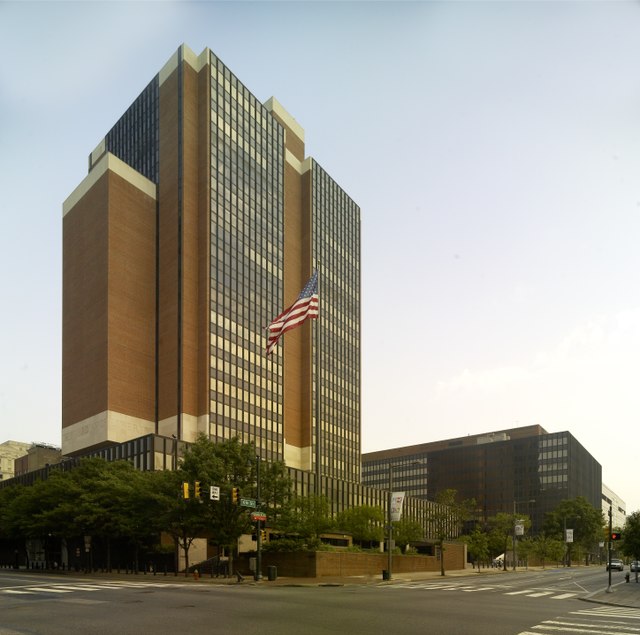
The Circuit Court for the Eastern District of Pennsylvania at the Byrne Courthouse, Philadelphia
Last Friday, the US Attorney’s office for the Eastern District of Pennsylvania announced that Carter Reese, an art and antiques dealer in Reading, Pennsylvania, was sentenced for knowingly selling forged artworks allegedly by twentieth-century masters.
Reese was well known in his community as an art dealer and historian. He previously taught history and art at the Hill School, a private preparatory school in Pottstown, Pennsylvania. He later served as director of admissions for the school before founding his own consulting company to help students with college admissions. His art and antiques collection is incredibly extensive as well. Court documents indicate that he owns approximately 17,000 items estimated to be worth $6 million. The forgery scheme was not a long-term aspect of his life, though. It mainly took place between 2019 and 2021.
During this time, Reese admittedly sold or tried to sell forgeries in the style of well-known artists such as Pablo Picasso, Joan Miró, Andy Warhol, Keith Haring, Fernand Léger, and many others. He worked with a Chicago-based forger who, several years ago, was convicted of selling $1 million worth of forged artworks. He would do this by buying prints or copies from websites like eBay and altering them to make them appear genuine. Reese created false provenance documentation to support the forgeries’ authenticity. When confronted with skepticism or questions, he vehemently denied any accusations that the works were fakes. However, when federal prosecutors charged him with mail fraud and wire fraud in May 2025, the 77-year-old dealer relented and pleaded guilty. Prosecutors say that Reese weaponized his reputation and good standing in his community to prey on potential buyers. The charges against him could have brought on a 40-year sentence. However, Judge Jeffrey Schmehl gave him sixty days in prison, four months of home detention, twenty months of supervised release, a fine of $50,000, and restitution of $186,125. Reese did not provide a reason why he undertook the scheme, but said to Judge Schmehl that he was “deeply and desperately sorry”.
At the sentencing hearing on Friday, individuals connected to the case were allowed to give victim impact statements on the full extent of Reese’s crimes. One such person was Christine Oaklander, former director of collections at the Allentown Art Museum. Oaklander was actually integral to Reese’s scheme falling apart. He convinced her to act as an intermediary in the sale of several works, which turned out to be forgeries. After the buyers confronted her, she contacted the FBI. After recording some of her phone calls, the FBI gathered evidence against Reese, which ultimately led to the charges. In her statement, Oaklander said that her reputation and mental health have been greatly impacted as a result of Reese’s scheme. She also said she spent about $130,000 of her own money to help Reese contact and negotiate with buyers. “Your behavior is incomprehensible,” she said to the court. Reese’s defense lawyer, Jason Hernandez, asserted that his client should not be sentenced to any prison time, given his advanced age. He also noted that Reese did not lie to or mislead investigators when confronted with the evidence of his crimes. Reese is also planning to auction off most of his personal collection to help raise the money for the fines and restitution payments he must now pay. While Judge Schmehl recognized Reese’s remorse and willingness to make amends as genuine, he nonetheless noted that jail time is necessary. “A meaningful sentence is, indeed, warranted in this case.” Carter Reese must report to prison on October 24th.