
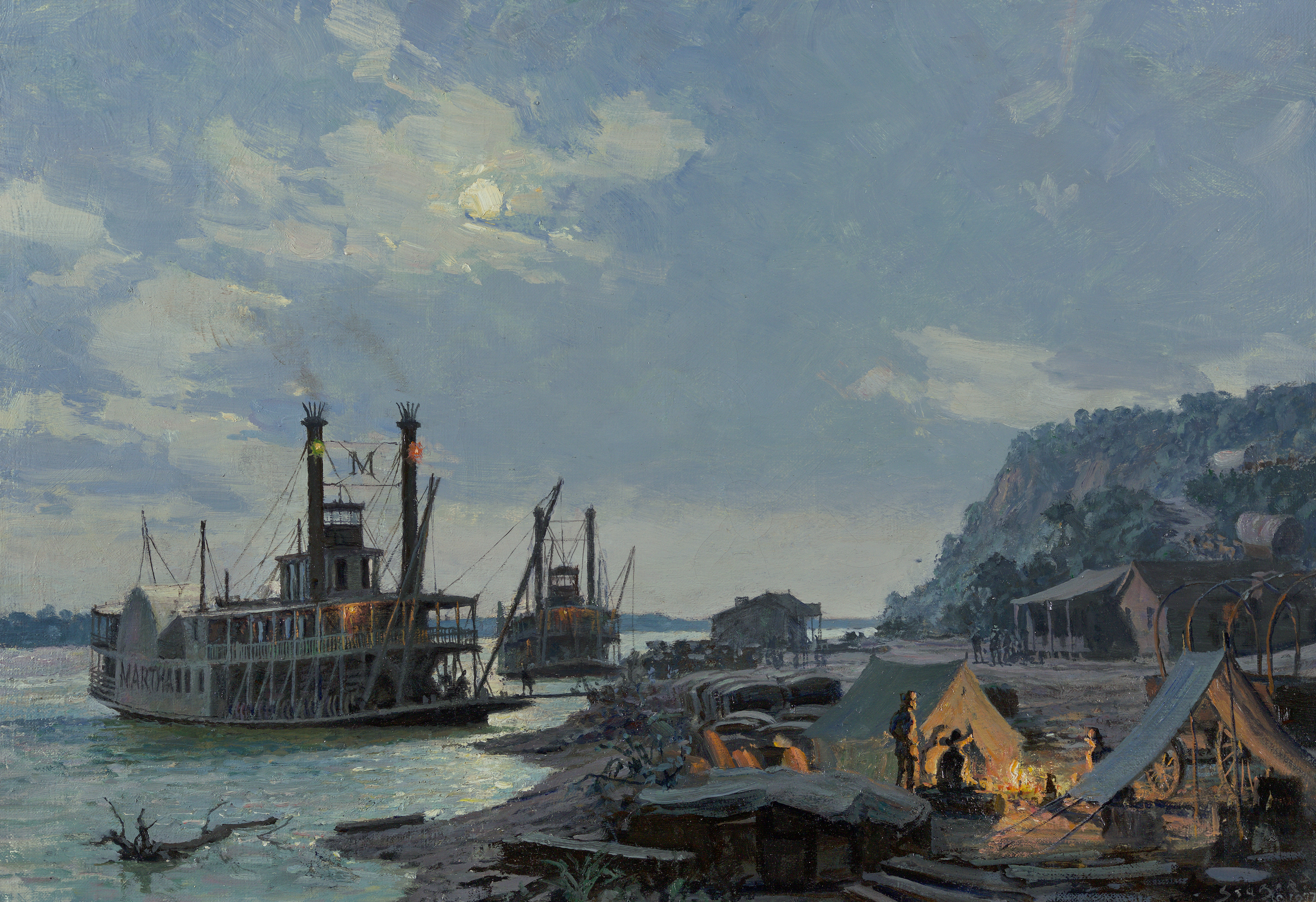
Independence, Wayne City Landing, 1842 by John Stobart
John Stobart was one of the greatest maritime painters of the twentieth century, specializing in painting historical sailing ships and harbor scenes as they would have appeared decades or centuries ago. But while clipper ships on the Atlantic or views of the Thames may be iconic in their own right, Stobart also had an interest in American paddle steamers, featuring them in many of his paintings. The present work, Independence, Wayne City Landing, 1842, depicts a duo of steamboats on the Missouri River making a nighttime stop in the small town of Wayne City Landing. The settlement, now known as Sugar Creek, sits between the river and the city of Independence, Missouri, just downstream from Kansas City. Wayne City Landing and Independence served as the starting point of many people’s journey into the west in the 1830s and 1840s (as anyone who played the Oregon Trail computer game at school would know). Stobart showed this on the far right of the painting, where covered wagons make their way up the bluffs, carrying goods and passengers that had previously traveled on the steam ships. Some of the supplies these ships carried were not just for the settlers’ journeys, but merchants along the Santa Fe trail would take a significant portion for them to exchange for goods that had come up through Mexico.
Independence, Wayne City Landing, 1842 is divided in half, with a serene, moonlit river scene on the left, but with the right showing signs of constant movement. Tents are pitched, a campfire illuminates the figures surrounding it, and the riverboat crews step across gangplanks to load supplies on and off. Stobart created several versions of this scene, with the present work exhibiting a more painterly technique. However, the looser brushstrokes are perhaps more appropriate for this subject. The area around Independence, Missouri, would have always been bustling regardless of the time of day. The movement of the ships being unloaded and the wagon trains on their way west meant that stillness and peace were rare along this part of the Missouri River. Furthermore, with just the moonlight, you wouldn’t be able to see every tree poking out of the hilltop or the outline of each barrel of supplies. In a strange way, Stobart’s abstraction makes it more real.