
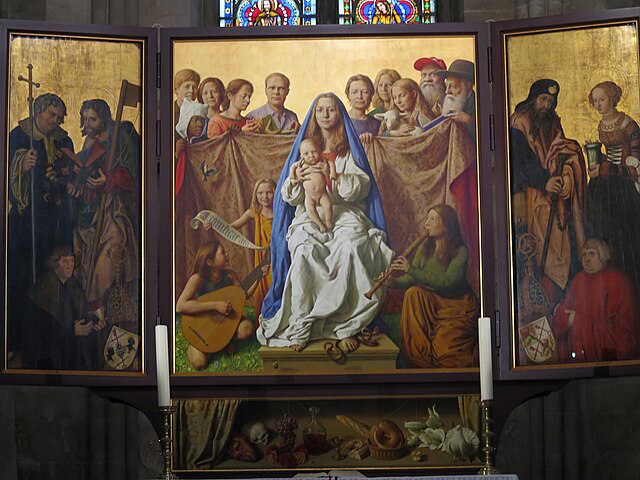
The Cranach-Triegel Altarpiece at Naumburg Cathedral (photo courtesy of ErichanderElbe)
Germany’s Naumburg Cathedral is at risk of losing its world heritage site status from UNESCO because of the placement of a somewhat controversial altarpiece.
Naumburg Cathedral is considered one of the most beautiful churches in central Germany. Much of the current structure was built in the thirteenth century, and now serves as a Protestant parish church. UNESCO granted the cathedral World Heritage Site status in 2018. However, that status is now threatened because of the congregation’s choice to display a rather unique work of art. The Cranach-Triegel Altarpiece is a combination of paintings by two separate artists separated by many centuries. The original triptych was created by the painter Lucas Cranach the Elder in the early sixteenth century. However, today, only the two wing panels survive. The center panel showing the Madonna & Child was destroyed during the Protestant Reformation’s iconoclastic efforts to remove and destroy art considered idolatrous. It wasn’t until 2022 that the German artist Michael Triegel created a replacement for the middle panel. There are no surviving images of Cranach’s original, so Triegel had to improvise slightly. His work is consistent with the general style of the two original wing panels, but contains several modern touches. Some of the figures surrounding the Virgin Mary and the infant Christ are dressed in more contemporary clothing. For example, one of the figures bears the likeness of Dietrich Bonhoeffer, a Lutheran theologian and anti-Nazi dissident, depicted as an old man wearing a red baseball cap.
When Triegel’s central panel was completed and combined with the remnants of Cranach’s original, the work was placed in Naumburg Cathedral’s west choir, where the altarpiece was originally displayed between 1519 and 1541. But while the church’s parishioners were very pleased with the painting, some artists and cultural specialists were less enthused. According to their objections, the altarpiece is an obstruction to another work of art kept in the church. The walls of the west choir are decorated with a series of twelve sculptures meant to represent the noblemen who contributed money towards the cathedral’s construction. The most famous of them are the statues of Eckhard II and Uta von Ballenstedt, the margrave and margravine of Meissen. The statue series is widely considered to be one of the greatest works of medieval German sculpture. The sculpture of Uta has been particularly influential, possibly serving as an inspiration for the design of the Evil Queen in the 1937 Disney film Snow White & the Seven Dwarfs. Upon the Cranach-Triegel Altarpiece’s installation in the west choir in 2022, the International Council on Monuments & Sites (ICOMOS) voiced its opposition to the church placing the painting there. The organization even considered recommending that the church’s status as a UNESCO World Heritage Site be stripped. The state government of Saxony-Anhalt intervened and requested that UNESCO determine whether the altarpiece was indeed detrimentally obstructing the sculptures. Experts examined the site in March 2025, determining that the painting could remain in Naumburg Cathedral but must move to a different location. Several cultural organizations suggested that the altarpiece could alternatively be placed in the cathedral’s north transept. This would allow visitors to view the medieval sculptures while placing the painting in a more central location. The state of Saxony-Anhalt’s cultural minister, Rainer Robra, commented on the situation, calling UNESCO’s decision “a positive outcome for our World Heritage sites and the citizens of Saxony-Anhalt through a solution-oriented process.”
However, the drama is not over yet. Despite UNESCO’s decision that the Cranach-Triegel Altarpiece could remain in the cathedral, the church’s parishioners have voiced their opposition to moving the painting out of the west choir. The congregation stated on August 7, 2025, calling UNESCO’s decision “a functional intervention”, as well as “a desecration of the altar and a disregard for its spiritual significance.” They highlight that the west choir was the original location of the altarpiece before its partial destruction during the Reformation. Therefore, if the church did not consider the work an obstruction to the sculptures at the time, it should not be considered one now. They argue that keeping the altarpiece in the west choir enhances the sculptures rather than obstructs them. The statues line the walls leading up to the altar, with the anonymous sculptor designing them to face or gesture towards it. The statues literally turn to face Christ and the Virgin Mary. Removing the painting to another part of the church would, therefore, be detrimental to the experience of both churchgoers and tourists since the space would be somewhat incomplete.
The church’s statement continues, “The current reconstruction of an altar at this location thus represents not only a liturgical decision, but also a conscious sign of reconciliation with history – a spiritual healing that does not suppress what was once destroyed, but rather reinterprets it with dignity.” The parishioners’ statement expresses that they were never consulted on whether the altarpiece should be moved. They therefore demand that the painting be kept in its current location out of “respect for ecclesiastical self-determination in sacred spaces”. Since Naumburg Cathedral is not a museum piece to be preserved but rather a space for “living tradition”, it only makes sense that the voices of those who attend the church, engaging in its historical and spiritual continuity, should perhaps not be drowned out by academics with little to no connection with the space.