
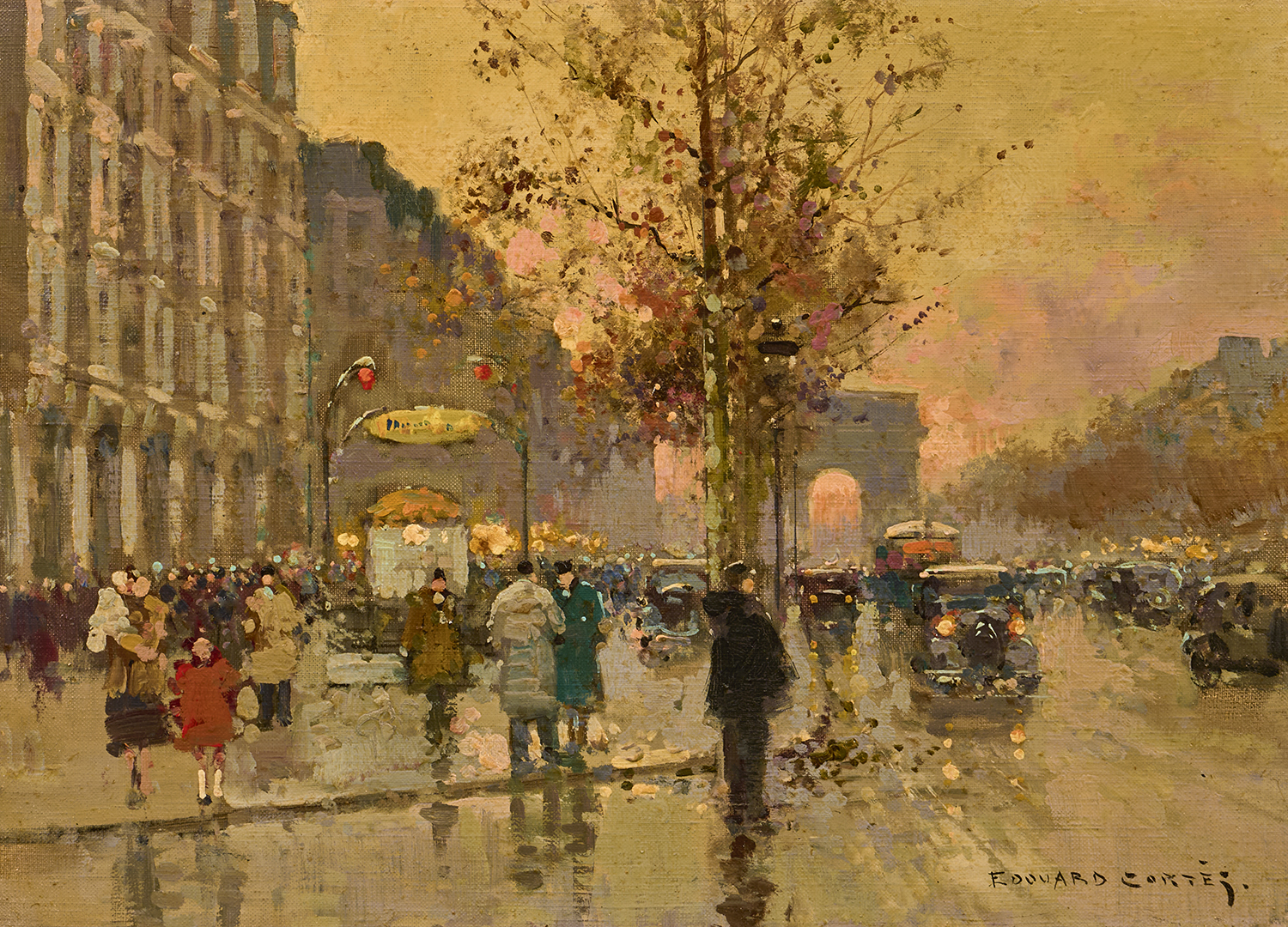
Métro George V, Champs-Élysées by Edouard Cortés
The Arc de Triomphe was a particularly common subject for Edouard Cortés. The square where the arch sits, the Place de l’Étoile (now the Place Charles de Gaulle), is the convergence of twelve different avenues, including the Avenue de Friedland, the Avenue Foch, and the Champs-Élysées. So, of course, there was no shortage of viewpoints for Cortés to use in his work featuring the Arc de Triomphe. While a street scene of the Champs-Élysées was a common subject in Cortés’s works, the inclusion of a Paris Métro entrance was a rare and intriguing addition.
The Paris Métro system first opened in 1900, with each station marked by distinctive Art Nouveau entrances, many of which still stand. The Métro station in the Cortés is the George V stop, located on the Champs-Élysées right in front of Louis Vuitton’s flagship location between Avenue George V and Rue de Bassano. The stop was previously called the Alma station, named after the Avenue d’Alma, which was renamed Avenue George V in 1918 in honor of the British monarch, the current king’s great-grandfather. This was a way to honor the alliance between Britain and France during the First World War. Nowadays, the stop is marked by a simpler, classical-style entrance, yet the Cortés painting shows the older, cast-iron gates flanked by a pair of red lamps. The painting, created around 1949, shows us Paris only five years following the liberation from the German occupation. Despite the war’s devastation, the city seems vibrant, with the sun’s light starting to fade in the west as the sky flashes pink through the Arc de Triomphe. While some of the artist’s work includes some of the city’s last horse-drawn streetcars, the Champs-Élysées is entirely populated by new automobiles now. Food rationing had only ended the year before, and France was ready to enter a new age of prosperity.