
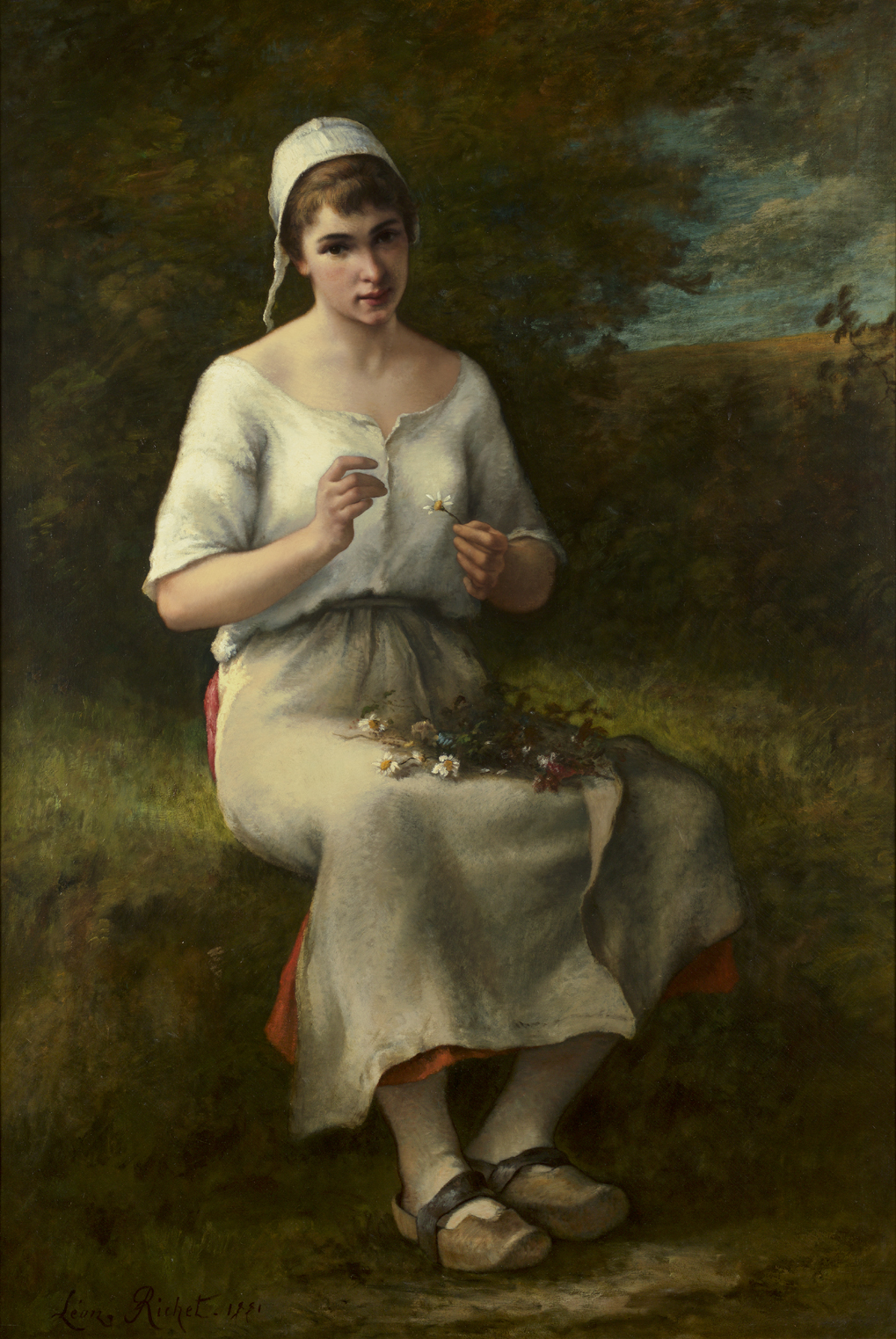
Marguerite by Léon Richet
While nineteenth-century paintings of French peasants often show them amid their work against a pastoral background, that cannot exactly be said about Léon Richet’s Marguerite.
This is a rather rare work for the artist, as he was considered more of a landscape painter. Yet influence from the Barbizon landscape painters can be seen throughout. Here, the artist gives us a large, full-length portrait of the titular peasant girl. Richet created this painting in 1881 and had it exhibited at that year’s Salon. He would not gain recognition from the Salon’s juries for another few years, receiving his first honorable mention in 1885 and his first medal in 1888. Although he had not received his accolades at the time of creating Marguerite, the audience can see how Richet builds on the revolutionary new styles that flourished during his lifetime. In the painting, the girl looks up, staring directly at the viewer, while in the middle of inspecting some flowers she’s just collected. It’s a private moment in which the audience has become somewhat of an intruder. The background shows influence from the Barbizon painters of the mid-nineteenth century, emphasizing landscape painting and the use of looser brushstrokes. However, the focus on the peasant girl indicates Richet looking to the Realist school of painting as pioneered by Gustave Courbet. Her simple outfit and wooden shoes fastened with leather straps, similar to those worn by the subjects of Courbet’s 1849 painting The Stone Breakers, are evidence of her incredibly humble status.
The influence of Realist art can also be seen in the work’s size. Richet’s Marguerite measures over five feet by three-and-a-half feet, a canvas size typically only reserved for portraiture of aristocrats and other wealthy patrons. The paintings of Joshua Reynolds and George Romney come to mind, as does the portraiture of Jean-Auguste-Dominique Ingres. This, however, is taking the lowly and ordinary and representing it on the same size and scale as the lofty and extraordinary. It’s the same idea behind why Courbet often used incredibly large canvases relative to the subjects of his work. Though created more than forty years after Courbet and the Barbizon painters created their first masterworks, their legacy is evident in the works of later painters like Léon Richet.