
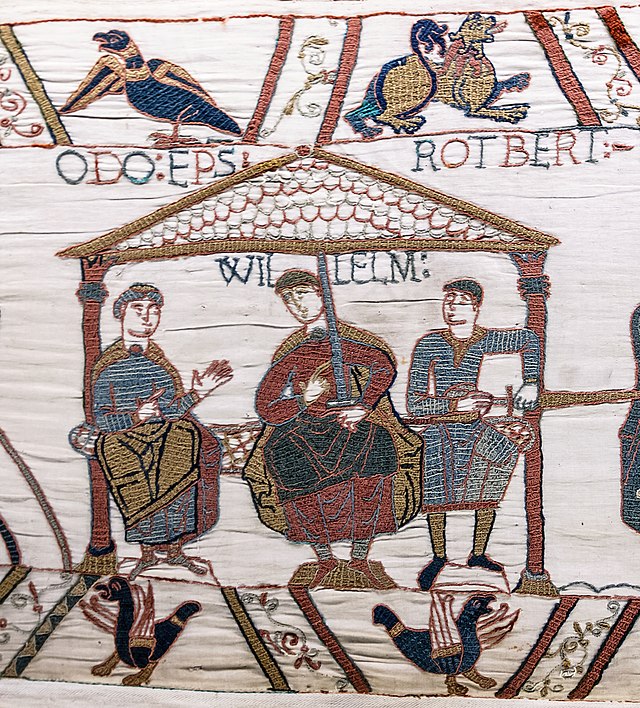
A segment of the Bayeux Tapestry, showing William the Conqueror in the center alongside his half-brothers Odo and Robert
The plan to loan the Bayeux Tapestry to the British Museum has received pushback in the form of a petition that currently has over 50,000 signatures.
In July, the British and French governments announced a cultural exchange agreement where a collection of Anglo-Saxon treasures would be temporarily loaned to French museums, while the famous Bayeux Tapestry would be loaned to the British Museum between September 2026 and July 2027. However, in the meantime, some in the French cultural sector have expressed their opposition to the arrangement. Most notably, the French art journalist Didier Rykner initiated an online petition, citing concerns that the work may be damaged during transport. In addition to the petition, several French cultural figures have expressed concerns about the arrangement. The Bayeux Tapestry Museum’s former director, Isabelle Attard, has commented that the tapestry should not leave its museum. “Its value is incalculable and if anything happens to it no amount of money and no other similar object can replace it.” She also noted that the Bayeux Tapestry is very fragile because of its age and previous treatment. Its current display has it sewn onto a textile support hung from a rail. It’s also been exposed to light continuously since it was returned to the museum after the Second World War. Rykner says he initially began his petition after conferring with several textile restorers and conservators, all of whom have said that the tapestry should not be moved from its museum. Rykner has refused to disclose the identities of these anonymous specialists, citing a supposed culture of fear that allegedly dissuades cultural workers from expressing their views. He alleges that many in the French cultural sector refused to speak out “because they’re not free. They’re all civil servants.” Rykner further commented, “The last two times it was moved were first by Napoleon and then by the Germans (during the Nazi occupation). I cannot think of why you would want to be the third to move it.”
Here’s the thing about Didier Rykner. His name has appeared in my news feed several times over the past few years. He’s been described in various ways, but I’ve settled on art journalist, since he’s primarily the editor of the online magazine La Tribune de l’Art. He is sometimes referred to as an art historian, although that title is not strictly accurate. He received a diploma from the École du Louvre in 1987, but does not possess an advanced degree in art history or conservation. The bulk of his education was in agronomic engineering. He first came to prominence in 2007 when he started a petition against the Louvre’s announcement to open a satellite location in Abu Dhabi. In a book he later wrote, he said the decision made the museum into “a commercial franchise”. Since then, he has described himself as “a militant for the heritage cause.” He has used his platform to draw attention to the ways French cultural heritage is being damaged, with demonstrable results. For example, in 2014, he wrote about the dangers imposed by the practice of leaving love locks on the Pont des Arts, how they weaken the bridge’s structural integrity. He also extensively criticized entrepreneur Vianney d’Alançon’s plans to transform the historic Château de la Barben into an attraction called Rocher Mistral, a theme park similar to Medieval Times. Rykner’s investigations formed part of an opposition that resulted in a court fining d’Alançon tens of thousands of euros for unauthorized construction. However, it can be easy to see Rykner as something entirely different: a cultural contrarian.
Rykner claims that, in terms of cultural heritage, everything created before the nineteenth century should be protected. While I agree that cultural heritage should be protected as much as possible within the realm of practicality, what results is a rather strict, immovable definition of cultural heritage that could actively harm the arts and our ability to protect and enjoy them. Critics like Rykner believe in a rather monolithic idea of culture, that it can only be one thing, frozen in time, kept under glass, completely removed from human experience. However, culture is created by people, and it changes over time, sometimes drastically so. Just the other week, I wrote about how churchgoers in Germany are trying to make this very point. Cultural authorities have informed the congregation that they cannot display a painting in a particular part of their church, as it allegedly obstructs visitors’ appreciation of a series of sculptures. However, the members of the congregation have emphasized that many spaces like their church are not museum pieces. They are spaces that still serve a practical purpose in their community. Rykner initiates petitions to completely halt all changes to heritage sites, without regard for the people who still frequently use them. The French government’s plans on installing contemporary stained glass windows in some of Notre Dame’s chapels are an example of this. Rykner has managed to gather over 200,000 signatures on that petition, suggesting that contemporary stained glass would be destroying something eternal and indispensable to French identity, which only dates back to the 1860s when the cathedral was last renovated.
Some reports from several years ago concluded that the Bayeux Tapestry should not be transported due to its age and fragility. However, other reports say that the work could be moved under strict safety protocols. Philippe Bélaval, director of France’s National Monuments Center and President Macron’s designated representative regarding the new cultural exchange agreement, cited a study from early 2025 that outlined extensive recommendations on how the work could be handled and transported. Another study from March 2022 determined the feasibility of transporting the Bayeux Tapestry from Normandy to London; however, the conclusions have been kept confidential by cultural authorities in Normandy. The art historical community is not united on this matter, but that does not mean that those urging caution should be disregarded. At the end of the day, the Bayeux Tapestry is property of the French state. So, an online petition may not be the best way to stop the work’s trip to London next year.