
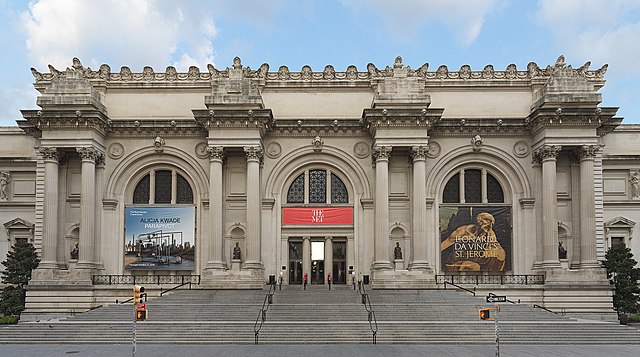
New York’s Metropolitan Museum of Art (photo courtesy of Hugo Schneider)
In recent years, museum curators and the general public have become increasingly aware that the partners of celebrated artists were often accomplished artists in their own right. Most notably, Pablo Picasso’s partner Françoise Gilot has experienced a museum and art market resurgence. But few women deserve this sort of recognition, however belated, more than Lee Krasner. On Sunday, October 4th, New York’s Metropolitan Museum of Art opened its latest major exhibit, Krasner & Pollock: Past Continuous. The show serves not only as a condensed retrospective of both Jackson Pollock and Lee Krasner’s work, but also explores their marriage and how each artist’s work was influenced by the other.
In the first major New York museum exhibition dedicated to either artist in more than two decades, Krasner & Pollock: Past Continuous presents their shared story in roughly chronological fashion, starting with their respective backgrounds. Krasner, the daughter of Jewish immigrants to New York, was greatly influenced by modernist painting coming out of Europe. She studied under Hans Hofmann, who influenced the later abstract expressionist movement by synthesizing the styles and techniques of painters like Cézanne and Kandinsky.
In the opening galleries, curators placed some of Krasner’s early abstract figure paintings directly across from examples of Pollock’s early work. The arrangement highlights the differences in their backgrounds and artistic education. Pollock was born in Wyoming and grew up primarily in California. Rather than drawing heavily from German and French modernists, he was influenced by the energy and rhythms of Thomas Hart Benton’s American Regionalist paintings, as well as the monumental, socially conscious works of Mexico’s muralist movement, led by artists such as Diego Rivera. According to the Met’s curators, Pollock and Krasner represent “two parallel art-historical tracks within the United States that needed to collide and cross-pollinate to create what became known as Abstract Expressionism.”
The galleries that follow explore how the two influenced one another throughout their careers. The Met shows that Pollock was not alone in experimenting with the drip technique. Alongside some of his earlier examples of “action painting”, as he called it, the exhibition makes sure to include some of Krasner’s own drip paintings, like an untitled 1947 work on loan from the Whitney Museum. By holding a brush just above the canvas and allowing the paint to fall, Krasner created densely layered patterns that scholars often describe as webs. Her approach differs considerably from Pollock’s, whose drip paintings are characterized by large splashes of paint and sweeping gestures across enormous canvases.

Other works reveal how both artists began incorporating everyday objects into their art. Pollock’s Full Fathom Five, one of the artist’s first drip paintings, contains nails, coins, buttons, and other debris trapped beneath layers of paint. These objects alter the painting’s texture and surface, making the work as much a physical object as an image. Met curators highlight this, noting the similarities with Krasner’s Mosaic Table on display nearby. Created around the same time as Full Fathom Five, she used coins, costume jewelry, keys, and the bottoms of glass bottles, arranging them within an old wagon wheel and pouring concrete over the top. Seen together, the two works demonstrate how both artists transformed ordinary materials into something entirely new.


The exhibition also emphasizes what made Krasner’s work distinct, particularly in its final galleries, which focus increasingly on the paintings she produced after Pollock’s death in 1956. These striking works show inspiration from natural imagery and floral motifs. Their color combinations and sweeping forms showcase Krasner’s dialogues with other artists such as Andy Warhol, Georgia O’Keeffe, and Henri Matisse. Her canvases also grew much larger, a nod to the monumental scale of her late husband’s work. Yet, the exhibition also included some of Pollock’s other work that appears inspired by the more vibrant natural imagery Krasner used for decades. The bright colors and looser brushwork in Easter and the Totem from 1953 offer a particularly compelling example of Pollock continuing to look toward Krasner, even as his drip paintings gained widespread recognition.

Throughout the exhibition, the curators often avoid taking a position on which artist first employed a particular technique. For visitors seeking a clear chronology of their artistic development, this approach may be frustrating. But it may also be the exhibition’s greatest strength. Attempting to establish who first used a specific technique risks reducing Krasner and Pollock’s artistic relationship to a simple call-and-response, casting one artist as the innovator and the other as the imitator. Instead, by showing how their work developed along similar paths, both independently and together, the Met offers a more fluid understanding of artistic evolution that recognizes the significance and originality of both artists.
Ultimately, the exhibition makes a compelling case that Pollock and Krasner cannot be fully understood when viewed in isolation from one another. Pollock might not have become the household name we know today without Krasner’s influence and support. And Krasner’s artistic development in the decades after her husband’s death cannot be separated entirely from the fourteen years they spent together. Rather than diminishing either artist’s achievements, Krasner & Pollock: Past Continuous demonstrates how their relationship helped shape two distinct but deeply interconnected artistic legacies.
Krasner & Pollock: Past Continuous will be on display through January 31, 2027.