
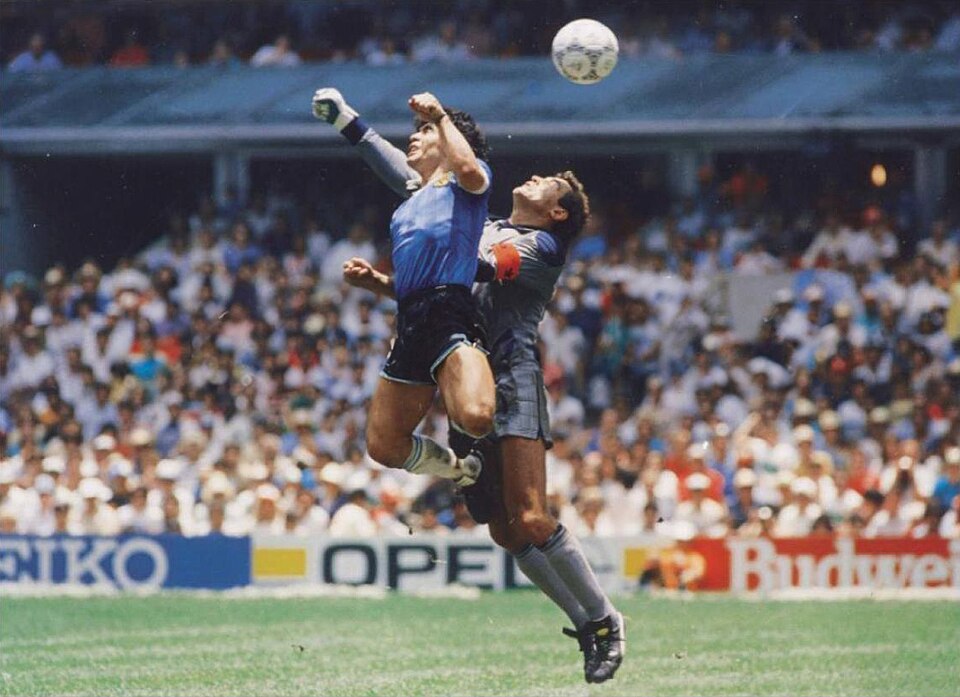
(opens in new tab) (opens in new tab) Diego Maradona making the “Hand of God” goal
On Saturday, August 22nd, Heritage Auctions in Dallas recently hosted a three-day series of sales focusing mainly on sports memorabilia. The three auctions featured over 1,600 lots, including a Honus Wagner baseball card(opens in new tab), a jersey worn by Wilt Chamberlain at the 1961 All-Star Game(opens in new tab), and a silver medal from the first modern Olympic Games in 1896(opens in new tab). While any one of these would have stolen the show at a normal sports memorabilia sale, what grabbed many collectors’ attention was just one lot: the soccer ball used during the World Cup match during which Diego Maradona scored the “Hand of God” goal and the Goal of the Century.
In 1986, Argentina and England were set to play each other in the quarterfinals of that year’s World Cup, hosted by Mexico. The two national teams had faced each other before at two previous World Cups. England had won both times, first at the 1962 World Cup in Chile and again as the host in 1966. The two countries had also been at war with one another only four years before, when the British repelled the Argentine military government’s invasion of the Falkland Islands. Despite the defeat leading to the military relinquishing power and greater political liberalization, it remained a source of national shame. Many Argentine commentators saw the quarterfinal match in Mexico as a chance for revenge.
At the Estadio Azteca in Mexico City, one of Argentina’s star players, Diego Maradona, led the team to victory by scoring two of the greatest goals in the history of soccer. The first and more controversial goal is popularly called the “Hand of God” goal. To knock the ball into the goal, Maradona leaped into the air just before it could reach English goalkeeper Peter Shilton. In doing so, Maradona hit the ball into the goal with his left hand. However, neither the referee nor the assistant referee saw the handball, and they counted the goal.
Only four minutes later, Maradona made the second goal, managing to dribble sixty meters past five English defenders in around twelve seconds. While the “Hand of God” goal is often bemoaned as one of the greatest miscarriages of justice in the history of organized soccer, few people dispute that Maradona’s second goal is one of the greatest displays of a player’s pure intelligence and athleticism in the sport’s history. According to Heritage, the two goals get to the essence of “the whole Maradona paradox”. While the Hand of God is “football’s most famous act of illegality ever ratified by a referee”, the Goal of the Century “is perhaps the clearest expression of individual genius ever seen on the tournament’s biggest stage.” Argentina ended up winning the match 2-1, and later won the entire tournament after defeating West Germany in the final.
In accordance with FIFA protocols, the ball was given to the match’s referee, Ali Ben Nasser. The ball comes with a 2023 letter of provenance from Ben Nasser stating that it was used for the entire game. It also states that Ben Nasser, the assistant referee Bogdan Dochev, and the two other match officials, Berny Ulloa and Idrissa Traoré, all signed the ball ”as witnesses to its significance. Independent authenticators have also confirmed that the item at Heritage is the game-used ball, noting scuffing, field marks, signatures, and other markings.
Heritage expected the ball to bring in as much as $10 million. These predictions likely reflected the auction success of Maradona’s jersey from the same match, which sold for $9.3 million in 2022(opens in new tab). While there was some serious interest at first, very few bids came in as the lot began to close. The hammer eventually came down at $2.75 million (or $3.35 million w/p). This still makes the ball one of the most expensive pieces of sports memorabilia ever sold at auction.