
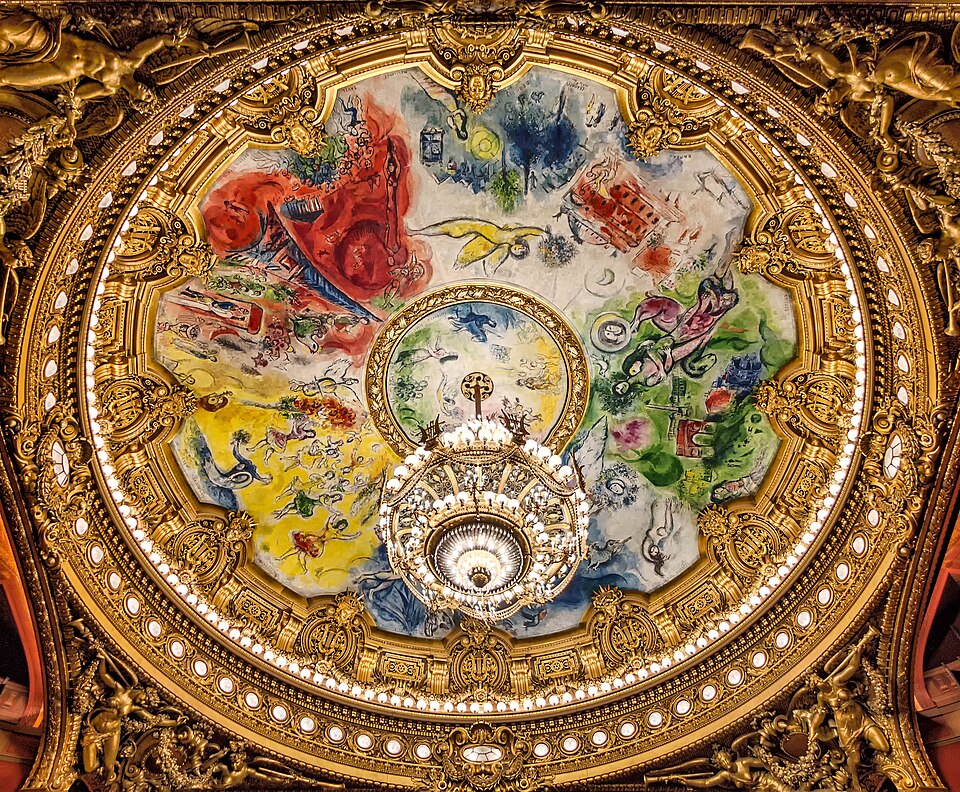
Marc Chagall’s ceiling at the Palais Garnier
Old requests have resurfaced to remove Marc Chagall’s paintings from the ceiling of the Palais Garnier, Paris’s main opera house.
The Friends of Lenepveu Society is an organization dedicated to preserving and promoting the work of the academic artist Jules-Eugène Lenepveu. The artist’s great-great-great-great-grandnephew, Arnaud Carayon, acts as the group’s president. For many years, he has been vocal about restoring his forebear’s work at the opera, even writing letters to both France’s president, Emmanuel Macron, and the culture minister, Catherine Pégard.
Jules-Eugène Lenepveu was a painter from Angers, a city in western France. After winning the Prix de Rome in 1847, he quickly became one of France’s most sought-after creators of historical and religious paintings. In particular, Lenepveu became known for his frescoes and decorative paintings for churches, theaters, and public buildings, most famously a series for the Panthéon in Paris showing scenes from the life of Joan of Arc.
By the 1860s, Emperor Napoleon III commissioned Georges-Eugène Haussmann to begin an urban renovation program to beautify Paris’s city center. One focal point of these projects was a new opera house designed by Charles Garnier. Having met while studying in Rome, Garnier selected Lenepveu to decorate the theater’s ceiling. He seemed a good fit for the job because he had created the ceiling design for the Le Peletier opera house, the previous home of the main Paris opera company. The resulting work, The Muses and the Hours of Day and Night, took two years to complete and mainly used figures from classical mythology.
But as traditional, academic art gave way to modernism, Lenepveu’s star faded. His work remained on the ceiling for nearly a century until 1964. That year, French culture minister André Malraux decided that the opera house needed an injection of modernity to make it more approachable and egalitarian. Malraux commissioned the Russian-born artist Marc Chagall to create a new ceiling design. Chagall created an homage not to mystical forces that provoke creativity, but to the flesh-and-blood people who created the art performed in that auditorium. Chagall’s ceiling features references to operas and ballets by Mozart, Beethoven, Tchaikovsky, and Gluck, as well as composers who would have been unknown in Lenepveu’s time, like Debussy, Stravinsky, and Ravel. Chagall’s modernist ceiling received less-than-friendly reviews when it was first unveiled. The most common critique was that the incredibly vibrant colors Chagall used proved disruptive or unharmonious with Garnier’s Second Empire-style building. However, it has remained, inspiring New York’s Metropolitan Opera House to later commission Chagall to create work for its lobby.
Writing for Le Monde, Michaël Moreau has compared these conversations to similar recent controversies over Notre Dame’s reconstruction and the decision to include contemporary stained glass. One could also compare other famous Paris monuments and buildings with more recent additions, such as I.M. Pei’s Louvre Pyramid or Daniel Buren’s columns at the Palais-Royal.
Carayon has previously stated, “Marc Chagall created a masterpiece, but that does not mean Lenepveu’s work should be rendered invisible.” Luckily, Chagall painted on canvases glued to a plastic shell. This protects Lenepveu’s original work and makes Chagall’s paintings easily removable. However, several options exist for the ceiling’s future beyond just keeping Chagall’s design or restoring Lenepveu’s work. Carayon has suggested sponsoring a rotating ceiling commission, in which a new ceiling by a contemporary artist would be installed every ten years. While it may not be popular with heritage purists, this sort of arrangement would reinforce the idea of a historic building as a site that changes with the times rather than being preserved in one state forever.