
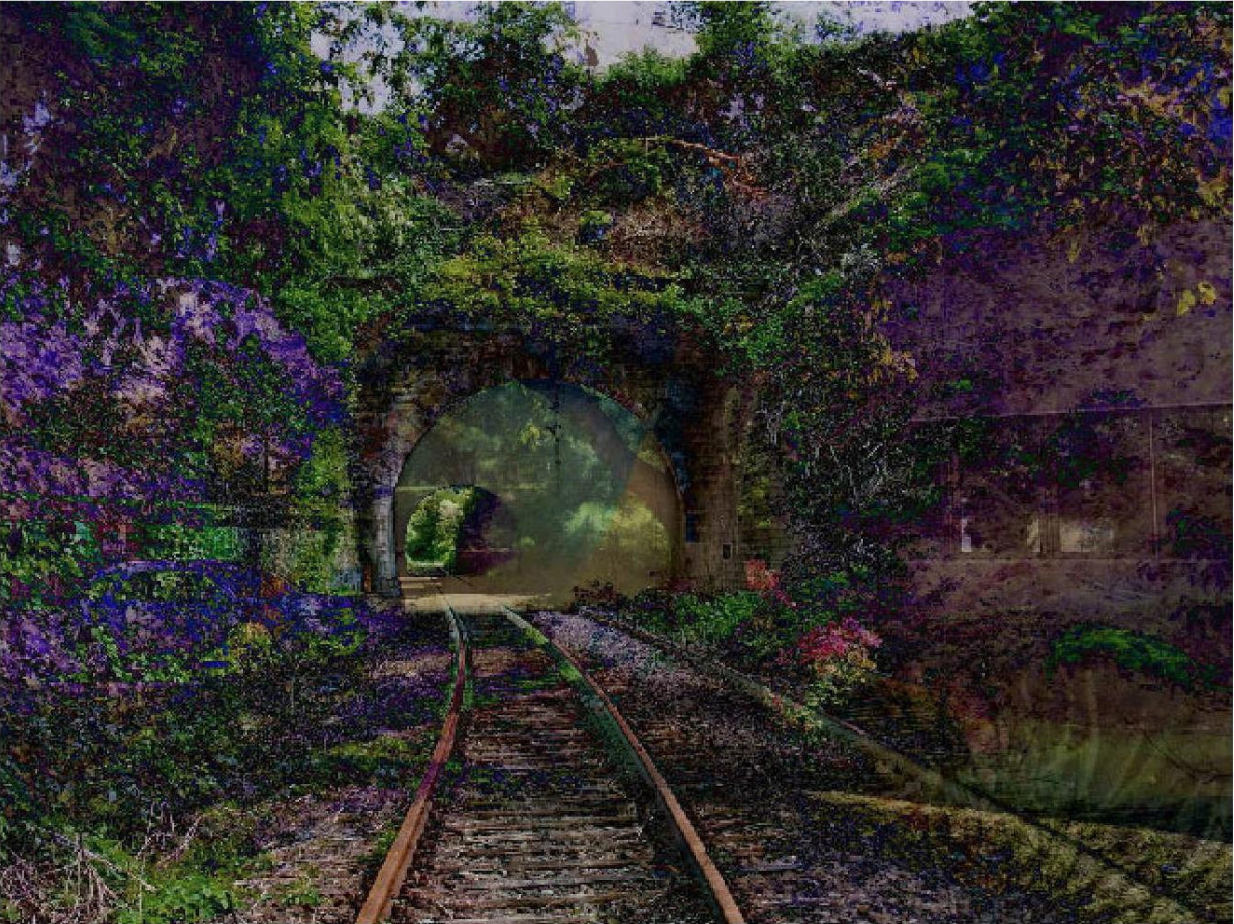
A Recent Entrance to Paradise generated by DABUS
The United States Supreme Court has refused to hear a computer scientist’s legal case, meaning that an artificial intelligence program he created cannot be credited as the author of a copyrighted artwork.
Several years ago, I wrote about Stephen Thaler and his legal battle to register a copyright for an AI-generated image. When I first heard of the case in August 2023, the district court for the District of Columbia held that an image created by an AI is not copyrightable. Thaler initially sued the US Copyright Office after it refused to grant a copyright for the image A Recent Entrance to Paradise. The image had been created by DABUS (Device for the Autonomous Bootstrapping of Unified Sentience), an AI system of Thaler’s own creation. The system is also sometimes known as the Creativity Machine. Thaler argues that not only can a computer program hold a copyright, but as the computer’s creator, he should be able to receive credit as well.
Judge Beryl Howell wrote that the Copyright Law of 1976 applies to any original work of any medium “now known or later developed”. However, human authorship remains one of the unchangeable characteristics of a copyrightable work. Howell further wrote, “Copyright has never stretched so far, however, as to protect works generated by new forms of technology operating absent any guiding human hand”. The court of appeals affirmed Howell’s decision last year.
Thaler first petitioned for the Supreme Court to hear his case in October 2025. In response, John Sauer, the Trump administration’s solicitor general, submitted a brief in opposition, urging the court to refuse to hear the case and uphold the validity of the lower courts’ decisions. Sauer wrote that while the Copyright Act does not explicitly define the word “author”, it is heavily implied that the word exclusively refers to humans and not machines, computers, or an AI. For example, the law states that a copyright “endures for a term consisting of the life of the author and 70 years after the author’s death.” It also specifies that upon the death of the copyright holder, the copyright will be transferred to the person’s widow, widower, or surviving children or grandchildren. To transfer a copyright, the copyright holder must sign an instrument of conveyance. According to Sauer, because a computer program lacks a measurable lifespan, next of kin, or the ability to sign a legal document, it must be inferred that copyrights can only be held by humans.
The Supreme Court has refused to grant certiorari, meaning that the court will not hear Thaler’s case and that his case has exhausted all remedies available in the legal system. Thaler’s lawyers commented, saying that the court’s siding with the copyright office has “irreversibly and negatively impacted AI development and use in the creative industry during critically important years.”