
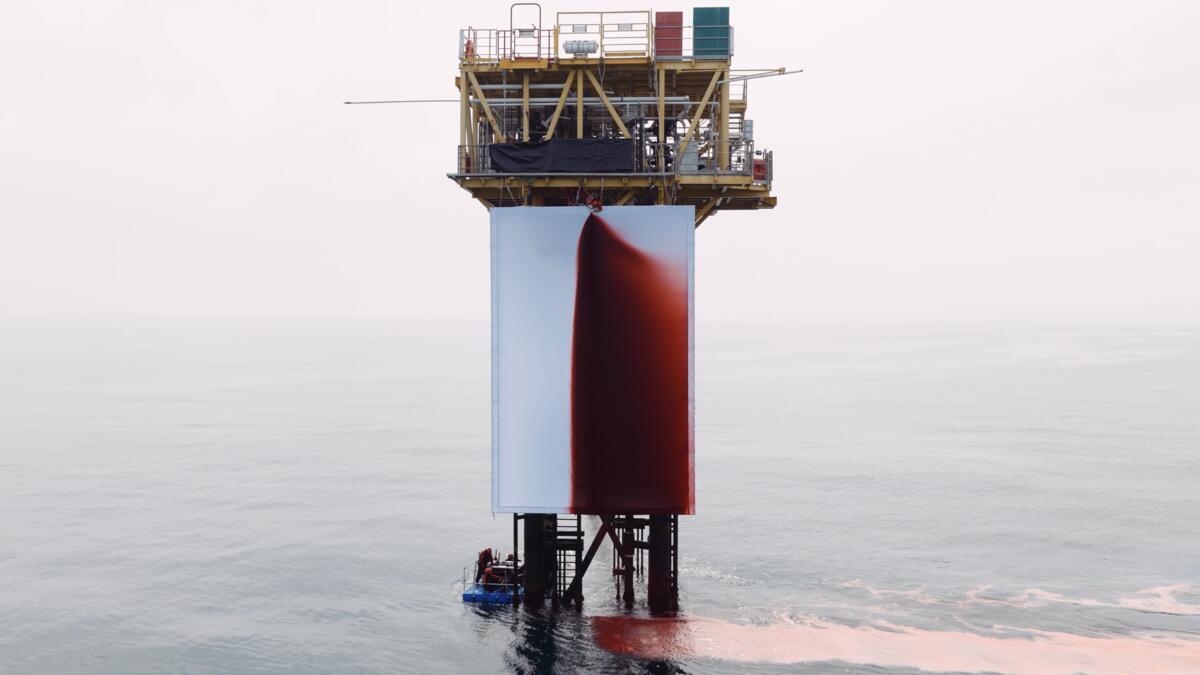
Butchered by Anish Kapoor, installed by Greenpeace activists on a North Sea oil rig (photo courtesy of Greenpeace)
Anish Kapoor, one of the most famous and influential living artists in the world today, has once again demonstrated the power of art in activism. While last week people used his sculpture Cloud Gate (also known as The Bean) to stage satirical protests and demonstrations, this week his work has been used for a very different purpose: as a protest against the fossil fuel industry.
On the morning of Wednesday, August 13th, a group of activists associated with Greenpeace traveled forty-five miles by boat from Norfolk, England, to scale an offshore gas rig operated by the petroleum company Shell. They unfurled a 96-square-meter canvas from the rig’s side, attaching a hose at the top and allowing 1,000 liters of crimson liquid to pour down, creating a harrowing image resembling a blood stain. The red dye used in the work is nontoxic and biodegradable, made with a combination of seawater, beetroot powder, and other substances. Kapoor has titled the work Butchered, a name that reflects the brutal impact of the fossil fuel industry on our planet. He commented, “The carbon dioxide released by burning fossil fuels is invisible, but we are witnessing the devastation that its extraction wreaks on our world. What still remains largely hidden is the responsibility oil giants like Shell bear for causing this destruction and profiting from worldwide suffering.” Kapoor touches upon an incredibly relevant issue for many. Governments and industry often shift the responsibility of climate change onto the public by urging reductions in plastic waste and gasoline usage. They are ready to discuss the carbon footprint of an individual, yet the impact of regular people is infinitesimally small when compared to that of large corporations. “I wanted to make something visual, physical, visceral to reflect the butchery they are inflicting on our planet: a visual scream that gives voice to the calamitous cost of the climate crisis, often on the most marginalised communities across the globe.”
This is not the first time Kapoor has weighed in on environmental issues. He was one of the most prominent art world figures who called for British cultural institutions to sever ties with British Petroleum (BP), something that the British Museum has failed to do. He has also worked with Greenpeace in the past, being part of its Polluters Pay Pact initiative, calling on governments to enact harsher restrictions on large, corporate polluters. According to a study published in April 2025 by ecologists Christopher W. Callahan and Justin S. Mankin, climate change caused by corporations has already caused $28 trillion in damage to the planet, with half of that number being attributable to just ten companies, including Chevron, British Petroleum, ExxonMobil, and others. Shell alone is estimated to have caused $1.42 trillion in damage due to the extraction and use of fossil fuels. Despite this, the company plans to create nearly seven hundred new projects, including rigs, pipelines, refineries, and other infrastructure, which would only add to the cost.