
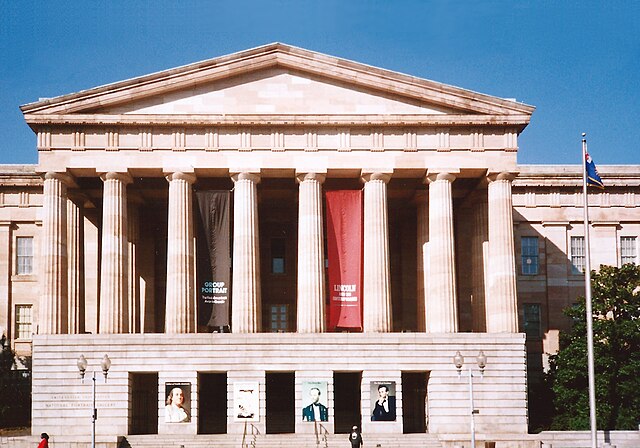
The Smithsonian’s National Portrait Gallery in Washington, DC (photo courtesy of Ida Berger)
American portraitist Amy Sherald has canceled her upcoming exhibition at the Smithsonian’s National Portrait Gallery over censorship issues.
Earlier this month, I visited the Whitney Museum of American Art to attend the first day of their Untitled (America) exhibition. However, it took me longer than expected to exit the museum as I got rather distracted by another show on display. American Sublime is the first museum exhibition dedicated to the work of Amy Sherald, one of the most prominent portraitists and realist painters working in the United States today. Much of the show focuses on her commitment to Black realism, a genre that emphasizes the self-representation of marginalized people free of exoticization. She intends to show Black Americans in the course of their everyday lives, or as she told Vogue, she is “an American realist, painting American people doing American things”. This was something that she felt was missing from American art that had already been filled in for white Americans by earlier painters such as Edward Hopper and George Bellows. Much of Sherald’s work consists of three-quarter length portraits of her subjects, all of them Black men and women in various poses or outfits against a single color backdrop, often a vibrant color. An interesting choice Sherald makes is not to use brown pigments to represent the skin color of her subject. Rather, she uses gray, inspired by old black-and-white portraits of her family members, which she said gave a greater dignity and elegance to the figures. Her mission and her style quickly caught the attention of the art world, especially after her painting Miss Everything (Unsuppressed Deliverance) won the Outwin Boochever Portrait Competition sponsored by the National Portrait Gallery. This caught the attention of Barack and Michelle Obama, leading to the NPG commissioning Sherald to create the First Lady’s official portrait.
She also became known for painting the portrait of Breonna Taylor, the 26-year-old emergency room technician who was shot and killed in her home in Louisville, Kentucky, while police were executing a no-knock warrant. Her death became a pivotal moment in the wave of social justice protests that swept across the United States in 2020. It led to the prohibition of no-knock warrants first in the city of Louisville, then in several states, and then on the national level in March 2024. Meanwhile, the officer who shot and killed Taylor, Brett Hankison, was only recently sentenced to just shy of three years in prison for excessive use of force and violating her civil rights. Sherald painted Taylor in a beautiful dress with her left hand sporting the engagement ring that her boyfriend, Kenneth Walker, had planned on giving to her. The painting was featured on the cover of Vanity Fair and was exhibited at the Smithsonian National Museum of African-American History and Culture. On top of her standard portraits, she has also recently begun to execute more large-scale work, placing Black subjects at the center of iconic American images. For example, If You Surrendered to the Air, You Could Ride It shows a man sitting casually at the intersection of steel beams, referencing the 1932 photograph Lunch atop a Skyscraper. For Love, and For Country is both a Black and queer reinvention of the famous photograph V-J Day in Times Square, showing a sailor planting his lips onto a nurse to celebrate the Second World War finally ending. However, there is one painting in particular that Sherald says caused some discomfort at the National Portrait Gallery, enough for her to cancel the show entirely.
Trans Forming Liberty is a larger-than-life portrait, measuring over ten feet in height. It depicts a figure in a blue satin dress, striking a pose similar to that of the Statue of Liberty. The subject holds a torch filled with daisies, and, like Lady Liberty, appears barefoot, with one foot in front of the other. But Sherald’s portrait is full of modern color, like her bright pink hair cut into a bob, matching eyebrows, gold eyeliner, purple lipstick, and a lavender background. The title suggests that the subject is a trans woman. According to Sherald, this painting is the reason why she decided to cancel the show. It seems the NPG became hesitant to exhibit this work as it would likely cause a hostile reaction from the current presidential administration. The White House has already embroiled itself in a battle to unilaterally alter the mission and content of the Smithsonian Institution, and recently got into a row with the National Portrait Gallery, specifically after President Trump tried to fire its director. The artist wrote, “I entered into this collaboration in good faith, believing that the institution shared a commitment to presenting work that reflects the full, complex truth of American life. Unfortunately, it has become clear that the conditions no longer support the integrity of the work as conceived.’’
I understand the National Portrait Gallery’s concerns to a certain degree since fear of retribution has become a powerful force in our current political climate. But how can we look to the arts as a refuge from this fear and a bastion of free expression if the institutions meant to display and defend the arts can sometimes be willing to make compromises regarding the value and safety of marginalized communities?