
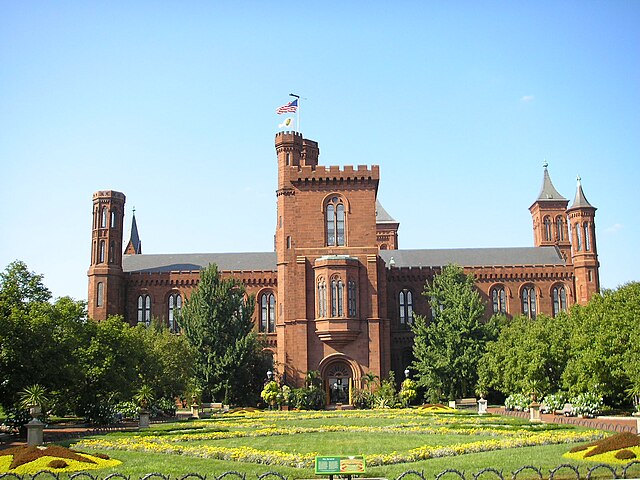
The Smithsonian Castle
The Smithsonian Institution’s director has taken a stand against the recent reforms and cuts pushed by the Trump administration.
While founded by the federal government, the Smithsonian has operated with little governmental interference since its foundation in 1846. This is mostly because the government set up the Smithsonian per the wishes of the British scientist James Smithson, who bequeathed his estate to the United States so that his collection, papers, and money could establish an educational institution. Nowadays, about 62% of its funding is appropriated by Congress. The Smithsonian now runs twenty-one museums and fourteen research centers, the largest complex of its kind in the world. It has never been the center of a partisan struggle for nearly its entire history. That is, until now.
In less than three months in office, Donald Trump has made it clear that he wishes to gut funding for the arts. He plans to eliminate the Institute of Museum and Library Services, placing its entire staff on administrative leave. He has also pressured Shelly Lowe, the National Endowment for the Humanities’ chairwoman, into resigning. On top of that, however, he also expressed his desire to establish a clear and controversial direction for the Smithsonian Institution. Trump recently criticized the Smithsonian, saying that the vast collection of museums and research centers actively promotes “improper, divisive, or anti-American ideology” that he seeks to eradicate. Section 2 of Executive Order 14253 specifically targets the Smithsonian Institution. It directs the vice president, as a member of the Smithsonian’s board of regents, “to effectuate the policies of this order through his role on the Smithsonian Board of Regents […] by seeking to remove improper ideology from such properties”. The board of regents also includes Chief Justice John Roberts, three members of the Senate, three members of the House of Representatives, and nine other members, including CEOs, publishing executives, and former museum directors. UMass Amherst history professor Samuel Redman remarked that this move is unprecedented. While there has been a bit of political wrangling in the past, “in terms of just overall funding and support for the Smithsonian, it’s been remarkably consistent.” Members of the board of regents are named and approved by Congress. However, since the Smithsonian has almost always held a special, non-partisan place in the minds of many Americans, some members of Congress may hesitate to approve new regents that would comply with Trump’s directives despite the president’s party holding a majority in both chambers. Some current regents, including Senator Catherine Cortez Masto, have already stated that they intend to maintain the Smithsonian’s integrity.
The Smithsonian’s director has now commented on the flurry of executive orders that target the nation’s museums and cultural institutions. Lonnie Bunch, in an internal memo to Smithsonian staff, rebutted the goal of the executive orders, saying that the Smithsonian’s goal will, as always, “be shaped by the best scholarship, free of partisanship, to help the American public better understand our nation’s history, challenges and triumphs.” He further added that the Smithsonian would “remain steadfast in our mission to bring history, science, education, research and the arts to all Americans”. The American Historical Association issued a statement supporting the Smithsonian against the recent executive orders. Several other organizations attached their names to the statement as well, including the College Art Association, the Civil Rights Movement Archive, the New England Historical Association, and the Society for US Intellectual History. Trump’s policies are not just an attack on the Smithsonian but also on academic freedom, artistic freedom, the freedom of expression, and the idea of a pluralistic society. It’s fortunate, then, that an executive order, in this case, doesn’t work like a royal decree. There will be significant pushback against these efforts, as we are already seeing.