
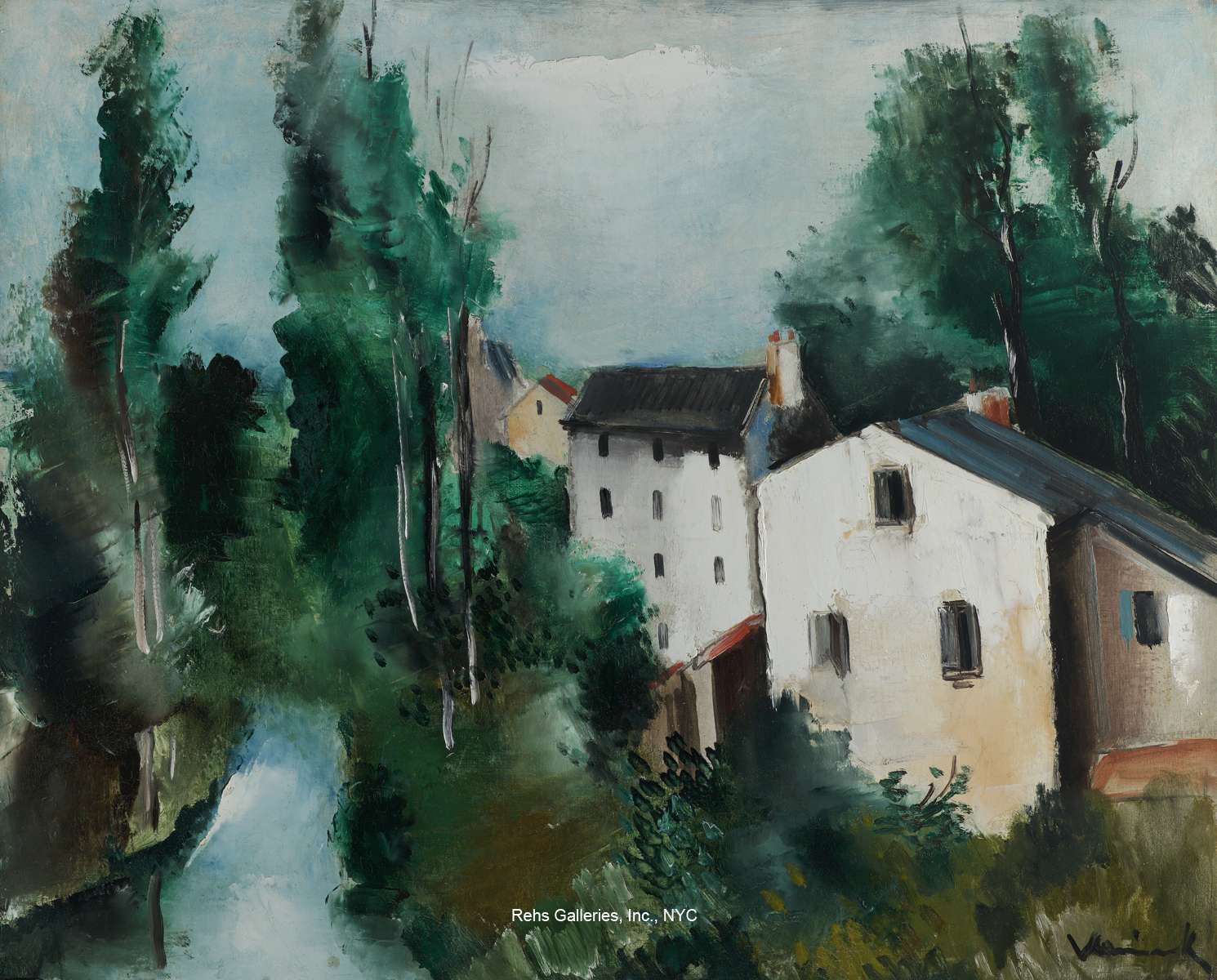
Maurice de Vlaminck
(1876 - 1958)
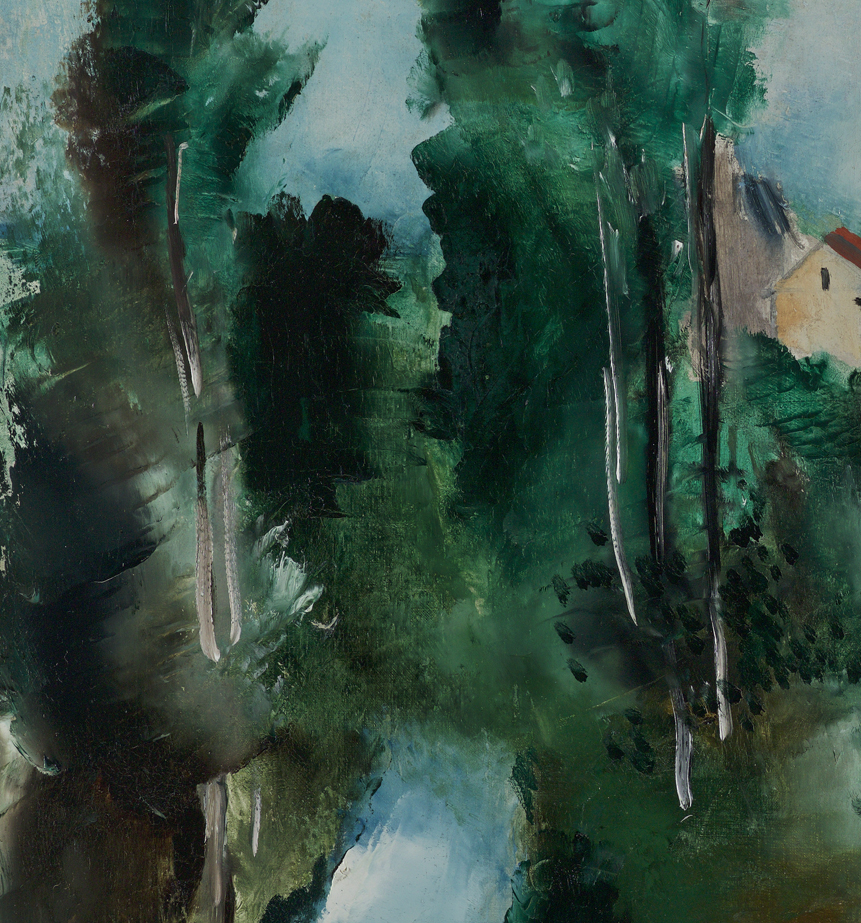
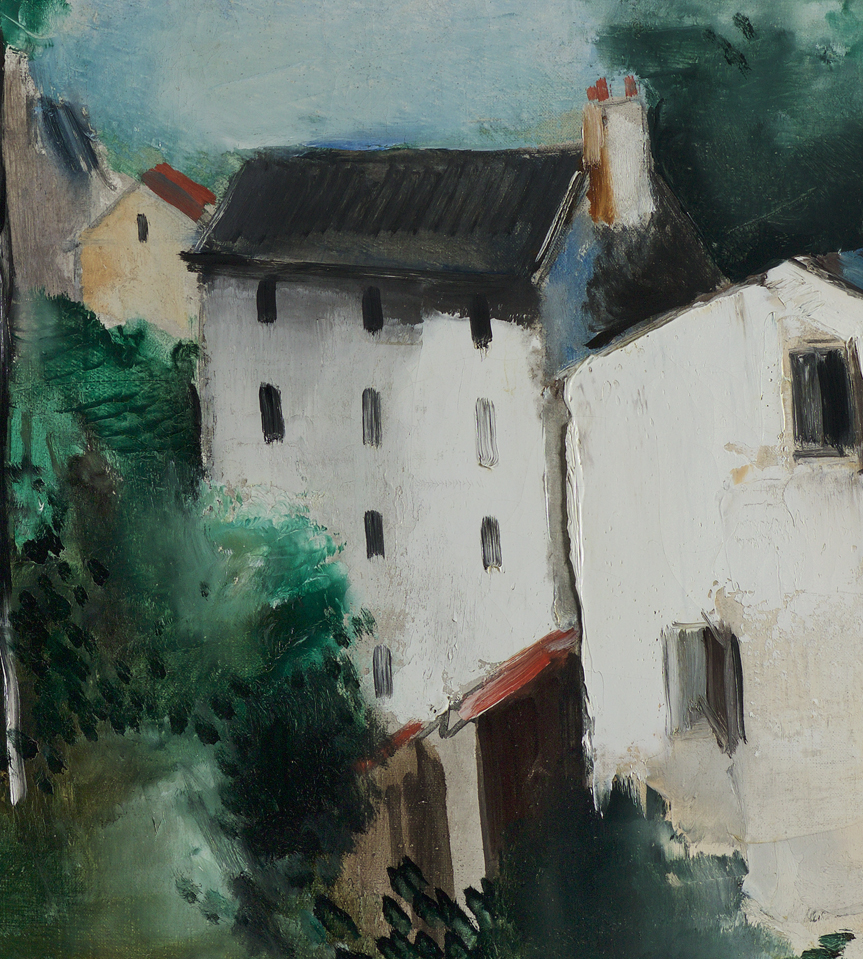
Maisons au bord de la Rivière
Oil on canvas
23 3/4 x 28 3/4 inches
Framed dimensions:
33 x 39 inches
Signed
BIOGRAPHY - Maurice de Vlaminck (1876 - 1958)
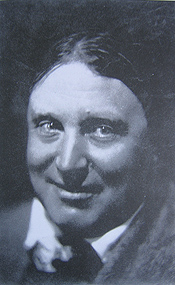
Vlaminck is entirely possessed by Vlaminck. It is his strength; dare I say, his virtue…
- Emmanuel Bénézit, Dictionnaire critique et documentaire des peintres, pg. 600
Lacking any formal artistic education, the visually intrepid artist Maurice de Vlaminck immediately took the Parisian art world by storm when he finally began to exhibit his works publicly at the age of thirty. He became known for his exuberant and uninhibited use of local color, confident execution, interest in color field representation, and a sensitive approach to nature. He produced an explosive combination that made these elements even more shocking to the public. Initially part of the Fauvist artists, Vlaminck freed himself from conventional ideals, taking the innovations of his predecessors like Van Gogh and Paul Cezanne one step further. In doing so, he introduced a new color palette that was unlike anything that had been seen before. As Vlaminck’s career progressed, he never lost his initial respect for and interest in the natural landscape. Vlaminck’s production in the latter half of his career shows his ability to experiment with new styles of representation and thus never lose the spontaneity that characterized his work from its earliest inception.
Vlaminck’s family was actually of Flemish origins. He was born in Paris on April 4th, 1876, at 5 rue Pierre Lescot, across from the Fontaine des Innocents. He spent his earliest years at his grandmother’s house near Les Halles, along with his parents and siblings, before relocating to the area of Le Vésinet when he was about three years old. While his grandmother worked in a market at Les Halles, his parents were both musicians. His mother, Josephine Grillet, was a pianist, while his father, Edmond Julien de Vlaminck, was also a pianist as well as a violinist and trained tenor. Vlaminck approached music as if it were his second nature, but it was never his love. However, the musical background provided to him during his childhood would prove to be a convenient means of earning income throughout the early part of his career.
Vlaminck first began his explorations in painting in 1893, painting “exclusively for myself, and nothing else”. This mindset would characterize his early career, explaining his reluctance towards public exhibitions. He did not exhibit until he was thirty years of age.[i] Vlaminck undertook brief artistic lessons with a teacher by the name of Robichon, a member of the Société des Artistes Français. He found himself more attracted, however, to the methods of Henri Rigal, with whom he painted in Chatou. While Vlaminck can technically be considered a student of both Robichon and Rigal, it is more appropriate to consider Vlaminck a motivated and self-taught student, one who can trace any artistic influences to other artists with whom he surrounded himself. Vlaminck was influenced by these experiences, but nevertheless created an artistic style that was all his own. He rejected the notion of the academic training that so determined many other artists’ careers. This rejection allowed Vlaminck to create an entirely new form of art and artistic temperament consistent with the experimentation coming at the end of the nineteenth century and into the twentieth. It was a “revolt against an established order in painting, a revolt against an established order in society, a same spirit of provocation…”[ii] He would revolt against contemporary artists and styles throughout his career, but through varied means.
In his early career, Vlaminck experienced several periods of financial hardship. He married Suzanne Berly at a very young age, with the two already having two daughters, Madeleine and Solange, by the time Vlaminck was just eighteen. He earned a meager sum through providing violin lessons and playing professionally in Paris orchestras that would play in a variety of local cafés like the Petit Casino de Montmartre and the Café des Princes. To support his family of four, he had to find other means by which to earn a living, and ended up taking several other jobs. These gigs included working as a billiards player, a writer, a general worker, and perhaps most surprisingly, a cyclist, competing in local competitions and in Holland, winning several races in the process. It was not until his struggle with typhoid in 1896 that Vlaminck quit racing. Vlaminck’s many “professions” must have overtaken his time to the point where any thought of an artistic career would have been unfathomable. Vlaminck even said that:
The thought of becoming a painter never as much as occurred to me. I would have laughed out loud if someone had suggested that I choose painting as a career. To be a painter is not a business, no more than to be an artist, lover, racer, dreamer, or prizefighter. It is a gift of Nature, a gift…[iii]
Further events interrupted Vlaminck’s progression to artistic success. In the autumn of 1897, he was called up for his mandatory three-year military service, registering with the 70th regiment stationed in the small town of Vitré in Brittany. His first known work, a decoration painted for a celebration of his regiment, was completed during his service in 1899. Several months after arriving, he was transferred to the army orchestra, allowing him much more freedom than was accorded to regular soldiers. He could not only give violin lessons, but he also had access to the library where he found himself admiring the writings of Victor Hugo, Guy de Maupassant, Alphonse Daudet, Emile Zola, and the theoretical writings of Denis Diderot and Karl Marx, among many others. Vlaminck was especially sympathetic to Zola’s work and ideals. It was under Zola’s banner that Vlaminck became a Dreyfusard during the tumultuous period in which Zola wrote his now-famous article, “J’accuse”, a politically charged statement against the racism and bigotry of the French government.
Ironically, it was during this period in the military that Vlaminck was converted to anarchist thinking. He questioned how anyone could “remain an individual if he had to conform with senseless orders and old foolish things without being asked his opinion on them.”[iv] He became involved with other artists and thinkers who were part of the extreme left wing of French politics. Later in his career, Vlaminck would write several articles in leftist journals, such as his “Croquis de Révolte” in Le Libertaire and Anarchie, and other writings in Fin de Siècle.
On a fifteen-day leave from his military obligations in July of 1900, Vlaminck serendipitously came into contact with the artist Andre Derain. According to the well-circulated story, the two men were traveling on the same train on July 18th when it derailed. Once Vlaminck was released from the army in September, he and Derain found a small studio to share in Chatou, a small village outside of Paris. Once an artistic enclave, Chatou had at one point been the home of Claude Monet, Frédéric Bazille, Pierre-Auguste Renoir, Gustave Caillebotte, Alfred Sisley, and Edgar Degas. However, by 1900, much of the town's artistic community had gone elsewhere, making it all the more suitable for Vlaminck and his rejection of overpopulated urban society. While others had moved out of the small town, it eventually became one of the centers of one of the most violently color-filled movements in twentieth-century art, and one of the first new movements of the century.
Vlaminck spent “a large part of boyhood” in Chatou, “passing time on the banks of the Seine”. It was in Chatou and along the Seine that he did his “first attempts, my first smears of paint… it was through them that I tried to render the emotion I felt while watching the river run through the countryside of the Parisian suburb”.[v] To Vlaminck, painting was an entirely personal and cathartic experience, unforced and unplanned. In Vlaminck’s words, painting existed to “bring back some order into my thoughts, to calm my desires, and especially to get a little purity into myself. I had not a single preconceived idea.”[vi]
With Derain, Vlaminck had finally embarked on his artistic career, though for himself and not for the public. The two men would be in each other’s close company for the next ten years, Derain the intellectual one and Vlaminck the impetuous one. To Vlaminck, “Neither Derain, nor myself, were what was conveniently called in this period the bohemians, the bad men: we were simply nonconformists, the outsiders”.[vii] The combination of the two men undoubtedly influenced the development of both of their styles. Their friendship should be viewed as a period of intense exploration for both artists, as it ultimately led to their emergence as leaders of a new style: Fauvism.
Vlaminck and Derain, while traveling sporadically, perfected their color technique in the midst of nature. Vlaminck was reluctant to bring his work to the public, not out of fear, but out of an initial idealistic rejection of such commercialized pursuits. He exhibited first at the Salon des Independents in 1904, but it was only after succumbing to the pressure of Henri Matisse that he showed the following year at the Salon d’Automne. There, he exhibited eight works, including Les Bords de Seine à Bougival (The Banks of the Seine at Bougival), La Fille de Ma Voisine (The Daughter of My Neighbor), Intimité (Intimacy), and Les Bords de Seine à Nanterre (The Banks of the Seine at Nanterre).
It was at this 1905 exhibition of the Salon d’Automne that the term fauves, or wild beasts, was first used, introduced into art historical jargon by the critic Louis Vauxcelles. As with the coining of many stylistic movements, it was a pejorative appellation. Initially amused by the fact that these paintings were inappropriately hung in the same room in which neo-Renaissance sculptures were placed, Vauxcelles was offended by the artists’ blatant use of color from the tube, their messy execution, and their rejection of an understandable concept of spatial relationships. These “wild beasts” contaminated the canvas with their child-like forms and color. Critics began to take notice of this group of artists. Some responded favorably, while others, like Vauxcelles, responded with indignation.
Despite the negative press, almost immediately after Vlaminck introduced the public to his daring works, he began to sell them to dealers. One fruitful relationship began with the forward-looking Parisian dealer Ambroise Vollard, who would support the artist for decades. Vollard initially purchased a single painting from Vlaminck for a seemingly paltry sum of 20 francs. Several days later, he offered Vlaminck 6,000 francs for all of the works in his studio. Amusingly, Vlaminck felt as if he had cheated the dealer and offered him a wood table that he himself had sculpted. Though Vlaminck began his public showings later than most, once he did finally begin, his name could be found on virtually all of the most progressive exhibitions and salons year after year: the Salon des Indépendants, Salon d’Automne, Exhibition de la Libre Esthétique, Exposition du Cercle d’Art Moderne, private gallery exhibitions, and others in France, Germany, England, Russia, the United States, Belgium, and other European countries. Vollard also encouraged Vlaminck to travel to England to paint the River Thames, doing so in 1911 during a two-week trip to London.
Fauvism had left the artistic scene almost as quickly as it appeared, dying out around 1907 or 1908. From 1907 into the next decade, Vlaminck’s style was in a period of transition. After a 1907 Cezanne retrospective, Vlaminck began to apply some of Cezanne’s geometric principles in constructing form and composition, and showed this influence until around 1910. His previous Fauvist interests were now being combined with, or perhaps challenged by, the intellectualized influence of Cubist works, producing a confusing set of influences which he struggled to reconcile. Vlaminck himself had become disillusioned with Fauvism, since with painting “directly tube against canvas, one soon becomes too slick… I regretfully realized that my composition was reduced to no more than a series of coloured rhythms, harmonious, discordant, monotonous and that, from simplification to simplification, I was falling into the trap of decoration…The decorative spirit was leading me to forget painting.”[viii] While Cubism was quickly beginning to influence the works of many artists, and while Vlaminck himself did produce some works inclined towards a Cubist perspective, it remained a somewhat mysterious method of representation for him. He later wrote that “Cubism was the negation of the art of painting. For years it wrought dreadful havoc.”[ix] Though he did not entirely give his work over to Cubism, he did share an interest in African art with other artists like Picasso or Braque and was a collector of African masks.
Vlaminck’s name became part of the most progressive groups of artists, exhibitions, and Salons. He maintained relationships, or at least acquaintances, with some of the most well-known names in the art world: Matisse, Braque, Picasso, among many others. He became the subject of solo exhibitions, such as that of 1908 at the Galerie Vollard in Paris. In 1910, the writer and critic Roger Fry organized an exhibition entitled Manet and the Post-Impressionists at the Grafton Galleries in London, which featured eight of Vlaminck’s works. The popularity of Vlaminck’s work continued to cross borders, as shown by his inclusion in the 1912 Blaue Reiter group exhibition in Munich. The German art magazine Der Sturm also put on exhibitions featuring Vlaminck's work, categorizing him as an Expressionist since the German Expressionists were the closest stylistic relation to French Fauvism. He was even a part of the infamous but influential 1913 Armory show in New York, the same show at which Marcel Duchamp’s Nude Descending a Staircase provoked a wave of criticism from American audiences unaccustomed to such a daring figural interpretation.
This was also a period during which Vlaminck himself began publishing his written works. In 1902, he published D’un Lit dans L’Autre, featuring thirty drawings by Derain. He also embarked upon another novel that same year, Tout Pour Ca, completed the following spring, with the main character inspired loosely by Derain. In 1907, he collaborated again with Fernand Sernada and published Ames de Mannequins. He continued publishing quite extensively throughout his career. Later in his career, in 1929, he would publish an important autobiographical work, Tournants Dangereux, a work subsequently published posthumously in English as Dangerous Corners.
At the outbreak of World War I, Vlaminck was sent to Rouen. After a few months, he found work in a munitions factory, where he remained for the next four years. The war left Vlaminck resentful and resistant to taking part in any of the victory celebrations. He rejected the prosperity of the post-war era and, instead of returning to Paris, moved to Valmondois and then, in 1925, to a farmhouse in Rueil-la-Gadeliere, which he called La Tourilliere. There, he retired, only returning to Paris to sell his paintings.
In his late career, Vlaminck continued in his fascination with the French landscape while also experimenting with the graphic arts. He began initially with woodcuts and engraving, but, after many years, turned towards watercolor. In 1921, he tried lithography for the first time, executing a lithograph based on one of his paintings, Coupe de Fruits (Glass of Fruit). Between 1926 and 1928, he actively worked with copperplate engravings. After 1930, he abandoned lithography for sixteen years. It was not until two years before his death that he returned to lithography to illustrate one of his literary works, La Tête Tournée.
Vlaminck remained at Rueil-la-Gadeliere from this point on. He painted landscapes, still-lifes, and flower paintings while simultaneously denouncing the modernist movements of the up-and-coming artists. This is in spite of the fact that he was one of these “modernists” early in his career. His vast output during this latter period of his career is, unfortunately, often overshadowed by his earlier Fauve works. Such an oversight neglects the fact that Vlaminck made astonishing changes in his late works, showing a competent artist at ease with the landscape. As he continued painting, his palette began to darken. His execution relied more on a naturalistic rendering of the landscape, one that may appear somewhat foreboding in its character. In these works, one finds a similar element in each: a barren road running through a small village dotted with small trees and simple homes. He became a master at rendering the tumultuous sky, contrasting deep, dark tones with an intense white that gives an added dimension to his works. His latter works should not only be appreciated for their confident execution and incredibly rich variation in tone and color, but for his unwillingness to sacrifice his interest in nature in favor of modernist trends. Perhaps it was his continuing understanding of color theory, perfected in his late career, that allowed him to paint such compelling canvases — a theory with which he was not entirely familiar in the beginning. He continued painting until the end of his career. He died on October 11, 1958, at his home in Rueil-la-Gadeliere.
Though Vlaminck admitted that early in his explorations with paint, he “composed by instinct, clumsily”, it was this freedom from past traditions, from academic training, from the necessity to pander to the public, that enabled Vlaminck to eventually become an artist sensitively yet often violently representing the natural world around him. Even towards the end of his career, given the opposing trends around him, he continued to maintain this freedom from other styles and continued to paint exactly that which inspired him: the landscape and the sea. He justified his methods, saying, “I put the colors there, with the one idea which for me excused everything: to say what I felt. I painted stutteringly, exclusively for myself, and that was all.”[x] But while Vlaminck is often only remembered for his Fauvist period, comprising less than ten percent of his total artistic career, it should necessarily be remembered that Vlaminck was an artist whose œuvre was in a constant state of transition. He started out with pure and unregulated color, but toward the end of his career moved into what seems to be a rejection of this initial propensity. He never deviated from his desire to depict nature. While his color and execution both may have become more “realistic” towards the end of his career, he should not be remembered solely as a Fauvist artist, but as a sincerely talented man who used his own emotion and artistic sensibility to create a body of work that spanned the decades and numerous artistic movements and styles.
Vlaminck’s two autobiographical works, Tournant Dangereux (Dangerous Corners) and Paysages et Personnages (Landscapes and Personages) are valuable sources of information about the artist’s life and career.
Selected Museums
The Metropolitan Museum of Art, New York
Museum of Modern Art, New York
Brooklyn Museum, New York
Dallas Museum of Art, Texas
Musée d’Orsay
Pushkin Museum, Moscow
Hermitage Museum, St. Petersburg
Art Institute of Chicago, Illinois
National Gallery of Art
Minneapolis Institute of Arts
Pola Museum of Art, Japan
Hiroshima Museum of Art, Japan
National Museum of Art of Romania
[i] Jacqueline Munck and Maïthé Vallès-Bled, Derain et Vlaminck: 1900-1915, (Milan: Gabriele Mazzotta, 2001), pg. 43
[ii] Ibid, pg. 23
[iii] Klaus G. Perls, Vlaminck (New York: The Hyperion Press: 1941), pg. 51
[iv] Ibid, pg. 42
[v] Munck & Vallès-Bled, pg. 108
[vi] Perls, pg. 50
[vii] Munck & Vallès-Bled, pg. 24
[viii] Maurice de Vlaminck, Tournant Dangereux (Paris: Librairie Stock, 1929), pg. 15
[ix] Jean Selz, Vlaminck (Milan: Uffici Press, 1963), pg. 64
[x] Perls, pg. 45